
Geomembrane Welding Methods Explained
Sheet is a commodity. Seams are not. Three welding methods, two testing regimes, and one simple test that tells you whether a weld is any good.
Why seams matter more than sheet
Intact HDPE has a permeability around 10⁻¹³ cm/s. Nothing gets through it. So in any real lined structure, the leak paths are the places where sheet meets sheet, or where sheet meets something else.
That is the whole argument for spending your attention on welding rather than on shaving dirhams off the material rate. A perfect sheet with a poor seam leaks. A modest sheet with a proven seam does not.
Hot wedge welding
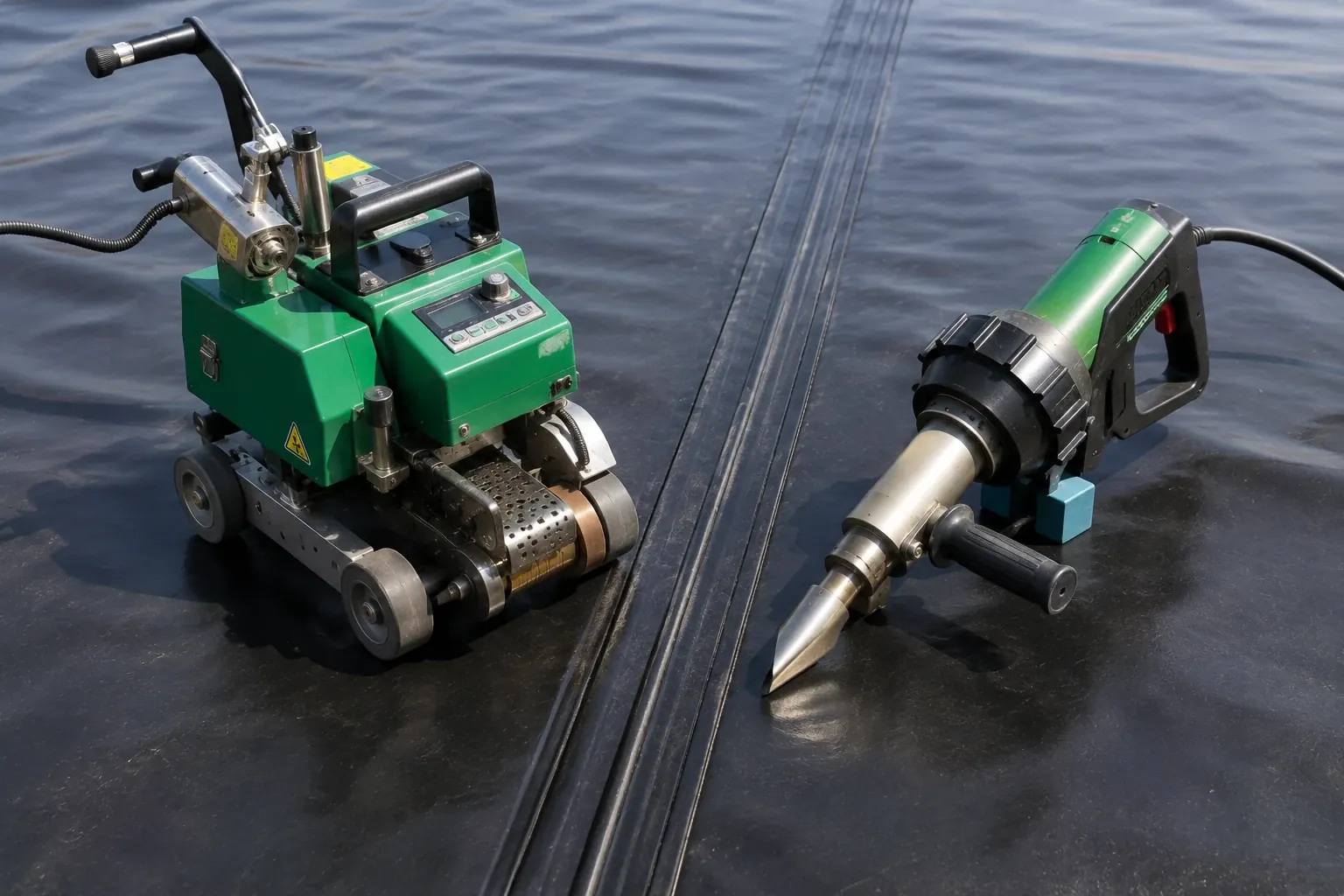
The workhorse. A self-propelled machine runs along the overlap between two panels. A heated metal wedge passes between the sheets, melting both surfaces, and drive rollers immediately squeeze them together under controlled pressure.
The important feature is that the wedge is shaped to produce two parallel welds with an unwelded channel between them. That channel is what makes the seam testable: seal one end, pressurise the other, and if the pressure holds, both welds are continuous along the entire length. No other method offers whole-length verification.
Variables the operator controls are wedge temperature, travel speed and nip pressure. All three interact with ambient temperature and wind, which is why parameters are re-proven whenever conditions change rather than set once in the morning.
Extrusion welding
A hand-held extruder feeds HDPE welding rod through a heated barrel and deposits a molten bead along the edge of an overlap, while hot air preheats the surfaces immediately ahead of the bead.
It is used everywhere a wedge cannot go: patches, repairs, T-joints where three sheets meet, pipe penetration details, sump corners, tie-ins to existing liner, and detail work around fixtures.
Preparation decides quality. The surface must be ground back to clean polymer — not sanded lightly, not wiped — within a short window before welding, because oxidation begins again immediately. A bead laid over an unground, oxidised surface may look perfect and have almost no bond strength.
Hot air tacking
A hot air gun softens two surfaces which are then pressed together. This holds panels in position against wind while production welding proceeds.
It is not a structural weld and should never be accepted as one. If someone offers hot air as the primary seaming method on a containment liner, that is a serious problem.
How each weld is verified
- Hot wedge seams → air pressure test. The channel is sealed, pressurised through a needle, and held. Pressure loss beyond the allowed drop means a defect. Crucially, the far end must be cut at the end of the test to confirm the pressure releases — otherwise a blocked channel looks exactly like a perfect seam.
- Extrusion welds → vacuum box. Soap solution, a clear-topped box, vacuum applied. Bubbles mean a leak path.
- Detail welds → spark test. Where a conductive wire is embedded under the bead, a probe detects any discontinuity.
- Both types → destructive samples. Coupons cut from production seams and tested in peel and shear on a field tensiometer.
The full acceptance criteria are set out on our installation page.
What a good weld looks like
Take a coupon and peel it apart. A good HDPE weld does not separate along the bond line. Instead the parent sheet itself tears — the failure runs through the material next to the weld rather than through the weld. The industry calls this a film tear bond, and it is the clearest possible evidence that the two sheets have genuinely become one piece of plastic.
A weld that peels cleanly apart at the interface, even if it required real force, has not fused properly. It has stuck. Those are the seams that fail two years later under sustained stress.
"Can I see today's trial weld coupon?" Any competent crew has one, cut and tested at the start of the shift. It takes ten seconds to look at and tells you more about the installation than an hour of discussion.
If you would like the welding and testing regime spelled out in a quotation rather than assumed, describe your structure to a team supplying and installing geomembrane across the UAE and ask for the method statement with the price.
Talk it through with someone who quotes this daily
Send your area, thickness and application. You get a written quotation with a roll schedule and material data sheet.
Answers for specifiers & buyers
Frequently asked questions
What is the best way to weld HDPE geomembrane?
Hot wedge welding for all long production seams, because it produces a testable dual-track weld, and extrusion welding for patches, details and repairs where a wedge machine cannot reach. Hot air is for temporary tacking only.
How strong is a welded geomembrane seam?
A properly made seam is as strong as the sheet. In a peel test, a good weld fails in the parent material rather than at the weld interface — the failure mode known as a film tear bond.
Can HDPE geomembrane be glued instead of welded?
No. HDPE has a low-energy surface that adhesives do not bond to reliably. Thermal fusion is the only dependable joining method. Materials that are glued or taped, such as EPDM, are joined that way because they cannot be welded — it is not an advantage.
Does weather affect geomembrane welding?
Considerably. Ambient temperature, wind and surface moisture all change the heat balance at the weld, which is why welding parameters are re-proven with a trial weld whenever conditions shift. In UAE summers welding is normally done in the early morning.
Read next
- Installation scopeHow welding fits into the whole install
- Repair and reliningWhat happens when a seam does fail
- Seam acceptance criteriaThe values a weld has to meet
Need a price on HDPE geomembrane this week?
Send the area, thickness and emirate. You get a written quotation with material data sheets attached — usually the same working day.