
Geotextile & Protection Layers
The layer beneath the liner that stops the subgrade puncturing it — specified against your ground and your sheet thickness, not picked off a shelf.
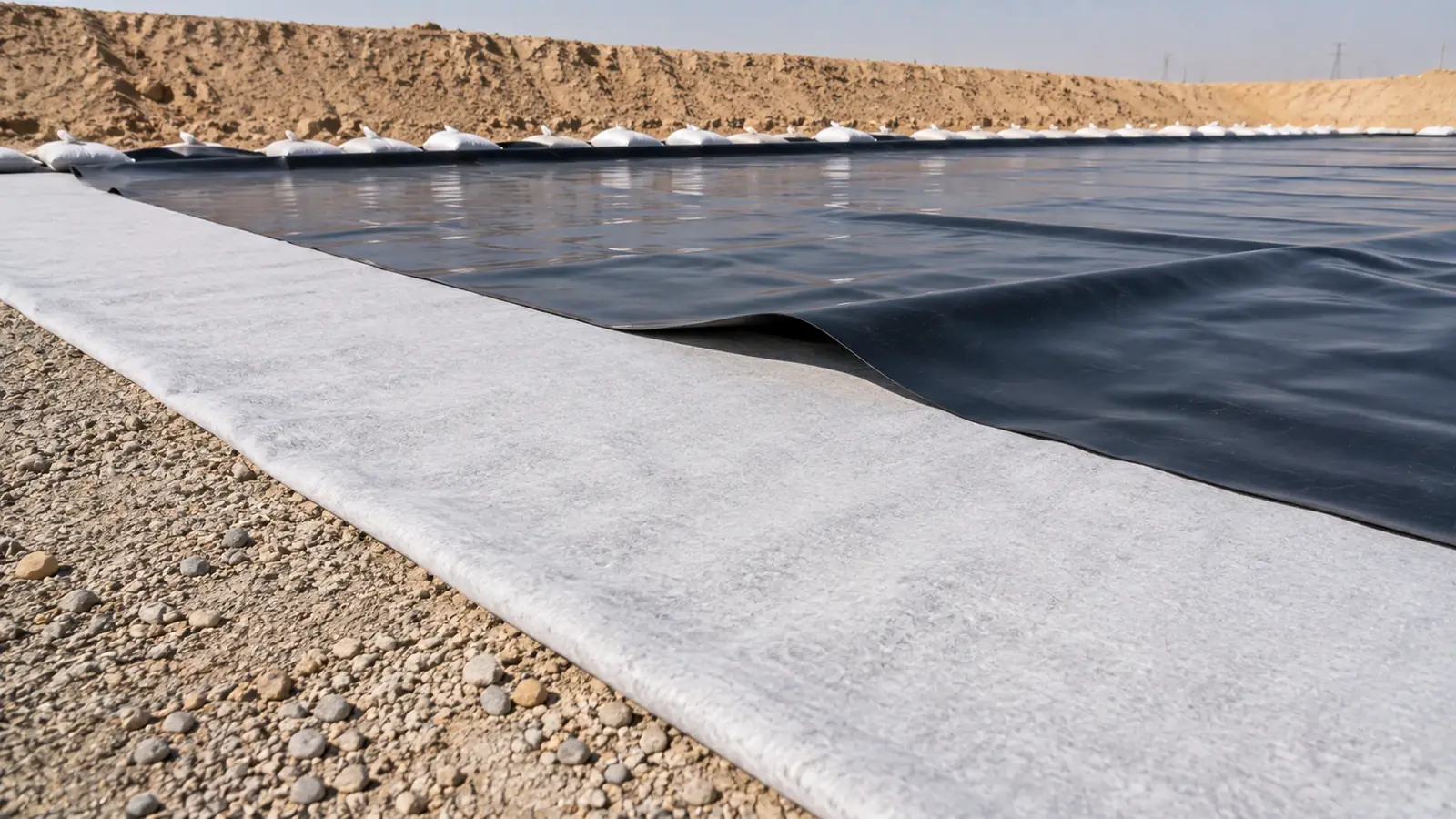
The layer that decides whether your liner survives installation
Most geomembrane punctures come from below, not above — a stone in the subgrade, a gypsum plate that breaks under a boot, a piece of construction debris nobody spotted. A non-woven geotextile cushion is the cheapest insurance available against all of them.
Geotextile is a needle-punched fabric supplied in rolls and laid directly beneath the liner, above it, or both. It does three jobs: it cushions the sheet against sharp material, it separates the liner from coarse fill, and where drainage is required it lets water move within the plane of the fabric.
We quote it alongside the liner rather than as an afterthought, because the right weight depends on the subgrade and the liner thickness together. Picking a geotextile independently of the sheet it is protecting is how people end up with either an unnecessary cost or an inadequate one.
A cushion geotextile typically adds AED 6–12 per square metre. Draining a full reservoir to locate and repair a single puncture costs far more than that across the whole area — before counting the lost water.
Selecting the weight
| Weight | Subgrade | Typical pairing |
|---|---|---|
| 150 – 200 g/m² | Clean screened sand, well-prepared fine subgrade | 0.75–1.00 mm liner in agricultural reservoirs |
| 200 – 300 g/m² | Sandy subgrade with occasional gravel or gypsum crust | 0.75–1.50 mm liner, the most common UAE specification |
| 300 – 400 g/m² | Gravelly ground, compacted fill, reclaimed sites | 1.00–1.50 mm liner, industrial and municipal work |
| 400 – 600 g/m² | Angular fill, quarry material, coarse rock | 1.50–2.00 mm liner, quarry and mining containment |
| 600 – 800 g/m² | Rock subgrade, or protection above the liner beneath heavy cover | 2.00 mm+ liner, landfill and severe-duty cells |
Weight is a proxy for protection, not a guarantee. Where the specification demands it, protection efficiency can be verified by cylinder testing on the actual materials rather than assumed from a data sheet figure.
Where the layers go
Below the liner — cushioning
The standard position. The fabric absorbs point loads from anything left in the subgrade and spreads the stress that would otherwise concentrate on a single spot of the sheet. On any subgrade with stone, crust or fill, this layer does more for liner survival than a thickness upgrade would.
Above the liner — protection
Used wherever material is placed on top of the liner: soil cover, drainage stone, concrete mattress, or plant trafficking during construction. Placing cover directly on bare geomembrane is one of the most reliable ways to damage a liner that passed every seam test.
Between two liners — drainage and detection
In double-lined cells, a geonet or thick non-woven layer between primary and secondary liners forms the leak detection layer, draining any escape from the primary sheet to a monitored sump.
Over soft ground — separation
Where a working platform has to be built over soft or wet subgrade, geotextile keeps the fill and the underlying soil from intermixing, so the platform stays a platform.
Installation notes
- Panels are overlapped and either sewn or heat-bonded at the joints, never simply butted.
- Non-woven geotextile degrades in sunlight far faster than a carbon-loaded geomembrane — cover it promptly rather than leaving it exposed for weeks.
- It must be ballasted against wind just as the liner is; a loose sheet of geotextile in an afternoon breeze is a hazard and a delay.
Get geotextile quoted with your liner
Give us the area in square metres, the liner thickness and the application. We reply with a written quotation, material data sheet and an indicative delivery date.
Answers for specifiers & buyers
Frequently asked questions
Do I really need geotextile under my HDPE liner?
If the subgrade contains gravel, gypsum crust, angular fill or construction debris, yes. On clean screened sand it can be omitted. Send photographs of the prepared subgrade and we will give you a straight answer rather than adding it as a default line.
What weight of geotextile should I use?
Commonly 200–300 g/m² beneath liner on typical UAE sandy-gravel subgrades, rising to 400–800 g/m² over quarry fill or rock, or where heavy cover is placed above the liner. The weight should be chosen against the subgrade and the liner thickness together.
Is geotextile the same as geomembrane?
No. Geotextile is permeable — water passes through it. Geomembrane is impermeable and forms the barrier. Geotextile protects, separates and drains; it never contains liquid on its own.
Can geotextile replace a thicker liner?
Often it is the better buy, because it addresses subgrade puncture, which is the main risk thicker sheet is used to mitigate. It does not extend UV service life, so for exposed liner the thickness decision still stands on its own.
Do you supply geotextile without geomembrane?
Yes, though most orders come alongside a liner. Tell us the weight, area and application and it will be quoted on its own.
Related pages
- Lining systemsWhere each layer sits in the build-up
- InstallationSubgrade preparation and deployment
- Thickness guideWhen a cushion beats a thicker sheet
Need a price on HDPE geomembrane this week?
Send the area, thickness and emirate. You get a written quotation with material data sheets attached — usually the same working day.