
HDPE Lining Systems
A liner is a sheet. A lining system is the sheet plus everything above and below it that keeps the barrier intact for its design life. Here is how the two get specified.
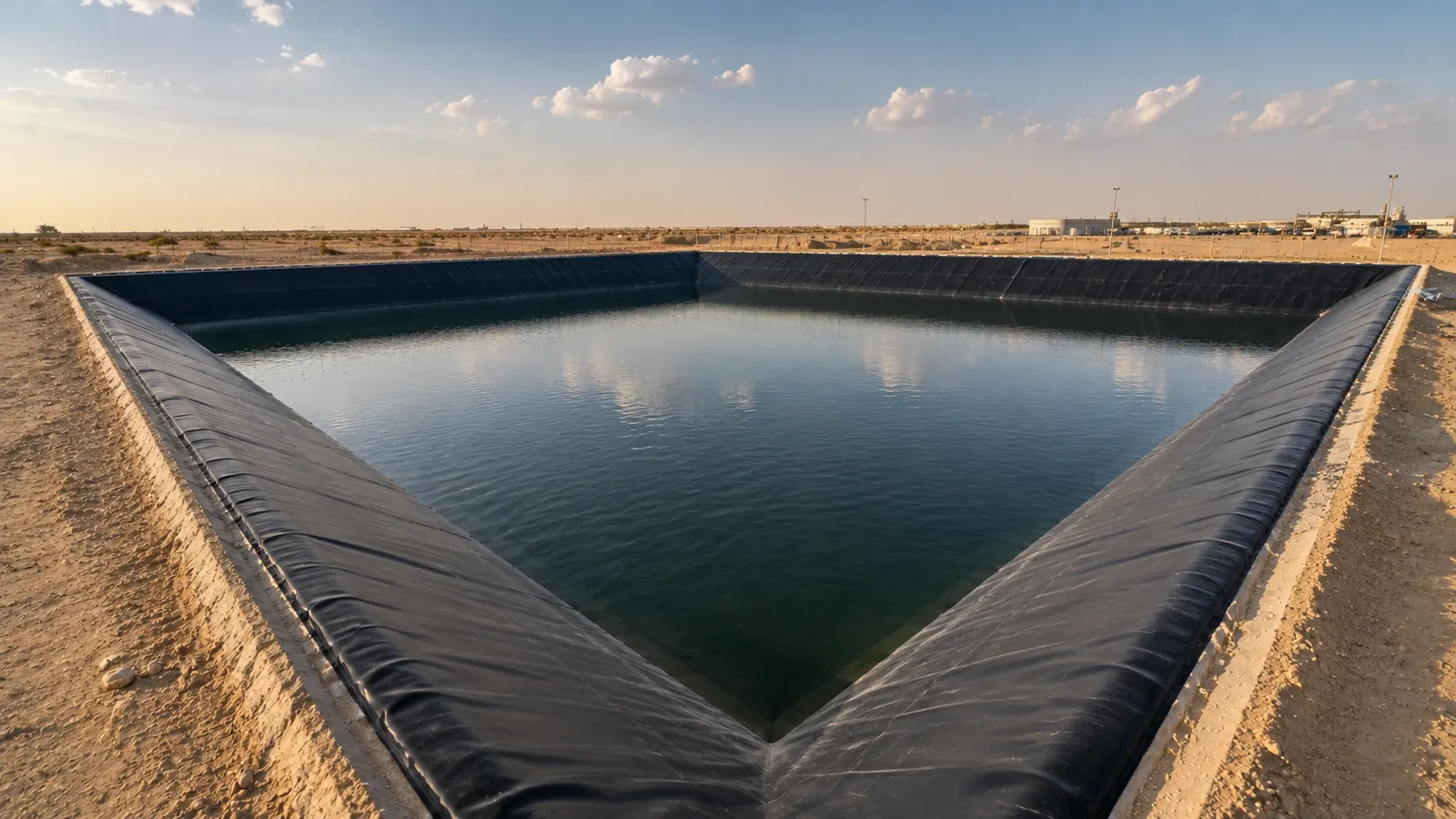
Choosing a lining system, not just a liner
"HDPE lining" describes a system: a barrier layer plus whatever is needed above and below it to keep that barrier intact for its design life. Getting the sheet right and the system wrong is a common and expensive mistake.
A farm reservoir may need nothing more than a single exposed liner over a clean sand subgrade. A leachate pond may need a cushion geotextile, a primary liner, a drainage geonet, a secondary liner and a leak detection sump. Both are "HDPE lining" — they are not remotely the same job.
What follows is how we pick between the configurations, and what each one is genuinely for.
What happens if this liner leaks? If the answer is “we lose water”, a single liner is proportionate. If the answer is “contaminated liquid reaches groundwater”, it is not.
The four lining configurations
| System | Build-up | Typical use |
|---|---|---|
| Single exposed liner | Prepared subgrade → HDPE geomembrane | Irrigation and farm reservoirs, construction water storage, fish ponds, decorative lakes |
| Cushioned single liner | Subgrade → non-woven geotextile → HDPE geomembrane | The same structures where the subgrade is stony, gypsum-crusted or reclaimed ground |
| Composite liner | Compacted clay or GCL → HDPE geomembrane → protection geotextile → cover | Landfill base lining, industrial containment where regulators require redundancy |
| Double liner with leak detection | Subgrade → secondary geomembrane → geonet drainage layer → primary geomembrane | Leachate lagoons, hazardous liquid storage, anywhere a leak has to be detected, not just resisted |
Cover systems are a separate decision again: liner can be left exposed, covered with soil or sand, protected with concrete mattress, or shielded with a heavy geotextile where plant will traffic it.
Structures we line
Water and irrigation reservoirs
The largest single category in the UAE. Seepage into permeable desert soils can waste an enormous share of stored volume; lining effectively takes that loss to zero.
Landfill cells and capping
Base lining to contain leachate and capping to keep rainfall out. Usually textured 1.5–2.0 mm sheet with a documented CQA package.
Leachate and effluent lagoons
Aggressive liquids and a real environmental consequence if they escape. Double lining with a leak detection layer is the standard answer.
Secondary containment bunds
Tank farms, chemical stores, fuel depots and wash bays. The liner has to resist the stored product, not merely hold water.
Canals and channels
Conveyance losses in unlined desert channels are severe. A single liner width running the length of the channel removes transverse seams entirely.
Aquaculture ponds and tanks
Fish and shrimp production, biofloc systems, hatchery tanks. Smooth liner, cleanable between cycles, no burrowing losses.
Decorative lakes and water features
Hotel, golf and community landscape water. Detailing around lights, pumps and fountains is where these projects succeed or leak.
Mining, brine and evaporation ponds
High salinity and long exposure. Thickness and resin quality carry the load here; thin sheet does not survive.
Details that decide whether a lining system works
The anchor trench
The liner is carried over the crest, into a trench, and backfilled. This holds the sheet against wind uplift and against the tension that develops as it settles. Trench dimensions come from the design, not from habit — a shallow scrape backfilled with loose sand is not an anchor.
Pipe penetrations
Every pipe through a liner is a potential leak. Inlets, outlets, drains and overflow lines are detailed with a fabricated boot extrusion-welded to the sheet and clamped to the pipe, or with a puddle flange cast into the structure. This is skilled work and it is where cheap quotes cut corners.
Sumps and low points
The liner has to follow the sump geometry without bridging. Corners are the hardest part of any lining job and need careful panel planning rather than improvisation on the day.
Gas and water venting
Where groundwater is high or organic material sits beneath the liner, pressure can build underneath and lift the sheet — the "whale" you sometimes see in a half-empty pond. Venting details or a pressure relief layer must be designed in at the start; retrofitting them means cutting the liner open.
Describe the structure you need lined
Give us the area in square metres, the liner thickness and the application. We reply with a written quotation, material data sheet and an indicative delivery date.
Answers for specifiers & buyers
Frequently asked questions
What is HDPE lining used for?
Containing liquid, or keeping it out. In the UAE that mostly means irrigation and municipal water reservoirs, landfill cells, leachate and effluent lagoons, secondary containment bunds at tank farms, canals, aquaculture ponds and decorative lakes. The same sheet serves all of them; the system built around it differs.
Is a single liner ever enough?
For clean water storage where a leak means lost water and nothing worse, yes — a single well-installed liner is proportionate and is what the majority of UAE reservoirs use. Where a leak would release contaminated liquid to ground, a double liner with a detection layer between is the appropriate specification.
Do I need geotextile under my HDPE liner?
If the subgrade contains gravel, gypsum crust, angular fill or any risk of sharp material working upward, yes. A 200–400 g/m² non-woven cushion costs a fraction of what draining a full reservoir to chase a puncture costs. On clean, screened sand subgrades it can be omitted.
Can HDPE lining be installed over concrete?
Yes. Concrete tanks and channels are lined regularly, either with the sheet mechanically fixed using embedded battens and profiles, or with a liner laid loose and anchored at the crest. Concrete surfaces must be smooth, with no protruding reinforcement or sharp arrises, and a geotextile cushion is normally used.
How deep can an HDPE-lined reservoir be?
Depth is limited by slope stability and by the interface friction between the liner and whatever is against it, not by the sheet itself. Steeper and deeper structures push you towards textured sheet, and at some point towards a geotechnical check on the veneer stability of any cover material.
Related pages
- Installation and weldingHow the system is actually built on site
- Reservoir lining guideSizing, freeboard, slopes and cover options
- Landfill lining explainedBase lining, capping and CQA requirements
- Price guideWhat each configuration adds per square metre
Need a price on HDPE geomembrane this week?
Send the area, thickness and emirate. You get a written quotation with material data sheets attached — usually the same working day.