
HDPE Liner Installation
Certified sheet is the easy part. This page sets out exactly how we prepare, deploy, weld, test and document a liner — and how to hold any installer to the same standard.
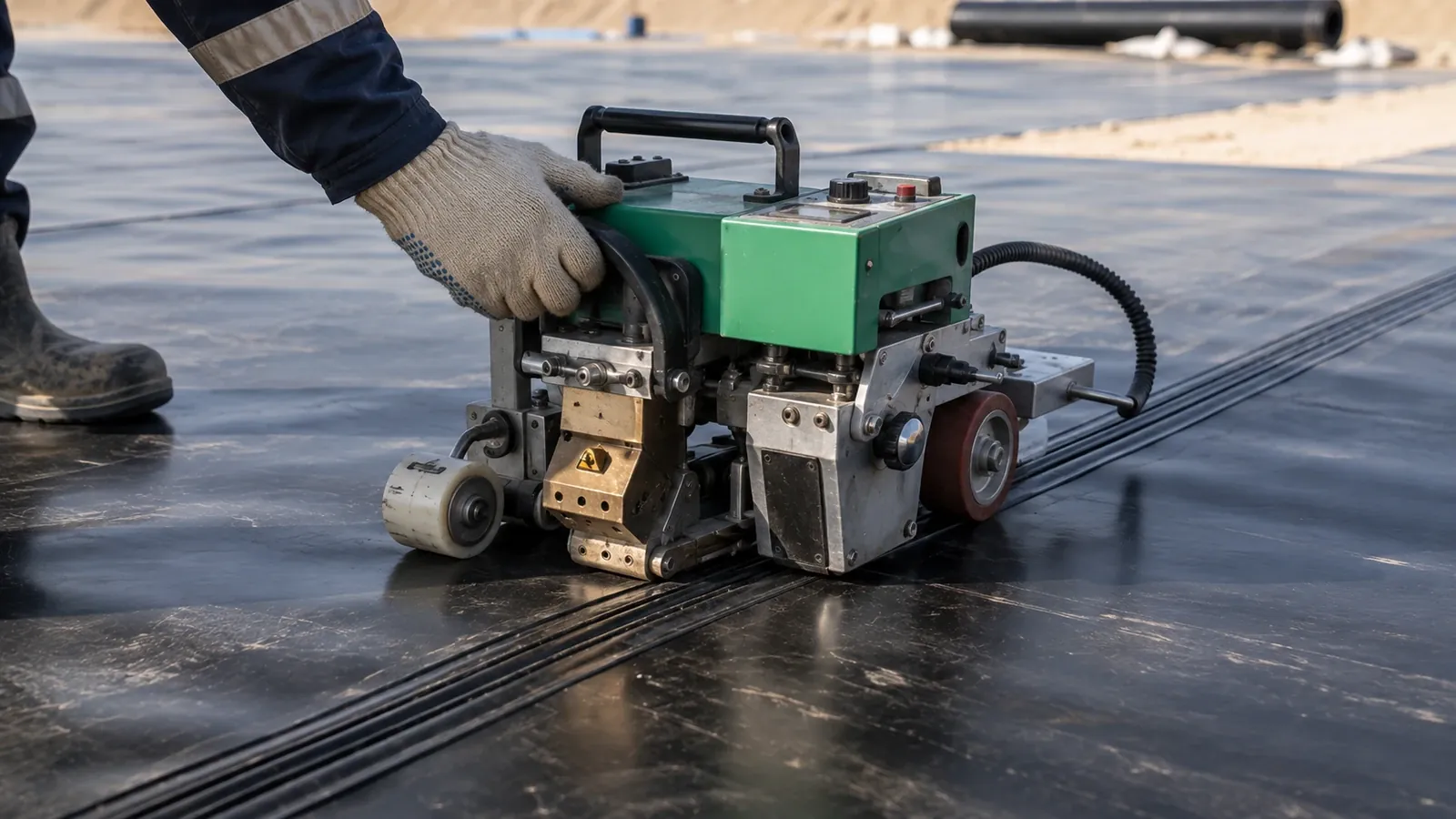
Installation is where the liner is won or lost
Sheet arrives on site as a certified, tested, factory-controlled product. Everything that happens afterwards is done by people, in the open, in the heat — which is why nearly every containment failure traces back to installation rather than to the material.
Our HDPE liner installation scope is built around that reality. The subgrade is accepted in writing before a roll is opened. Panels are laid to a numbered layout. Every seam type has a defined welding method and a defined test. Trial welds are cut and tested at the start of each shift and whenever conditions change. And the whole record goes into a file you can hand to a consultant.
None of this is exotic. It is standard practice in the geosynthetics industry and it is what separates a lining installation from a sheet-laying exercise.
“Show me an air pressure test log from a recent job.” A crew that tests seams properly will have one ready. A crew that does not will explain why it is not necessary.
| Stage | Included |
|---|---|
| Subgrade acceptance | Yes, recorded |
| Deployment | To numbered panel layout |
| Seaming | Hot wedge + extrusion |
| Non-destructive testing | Air pressure, vacuum box, spark |
| Destructive testing | Peel and shear on trial welds |
| Handover | As-built QA file |
Preparing the subgrade
More liners are punctured by the ground beneath them than by anything above them. Subgrade preparation is not a formality before the interesting work — it is the work.
What a good subgrade looks like
- Shaped to the design profile, with slopes no steeper than the design allows and no abrupt changes.
- Proof-rolled and firm enough to walk on without heel marks.
- Free of roots, rubble, construction debris and any stone above the size the specification allows — typically nothing larger than about 12 mm at the surface.
- No standing water, no soft spots, no wheel ruts.
- Anchor trench excavated to profile around the crest, with the edges rounded.
UAE-specific subgrade issues
- Gypsum crust. Common inland. It breaks into sharp plates under load and is a frequent cause of puncture — a cushion geotextile is strongly recommended over it.
- Windblown sand. A prepared subgrade can be buried or scoured overnight. Prepare in sections that can be lined the same day rather than opening the whole area at once.
- Sabkha and high water table. Coastal sites can develop uplift pressure under the liner. Where groundwater is close to the base, a venting layer or pressure relief detail should be designed in.
- Loose sand slopes. Fine sand at 1V:2H tends to ravel under a working crew; flattening the slope or compacting with moisture control saves rework.
Welding methods
| Method | Used for | How it works | How it is tested |
|---|---|---|---|
| Hot wedge (dual track) | All long production seams between panels | A heated wedge melts both sheet surfaces, which are then pressed together by drive rollers, forming two parallel welds with a sealed air channel between them | Air pressure test of the channel — pressurised, held, and the pressure drop measured |
| Extrusion welding | Patches, repairs, detail work, pipe penetrations, T-joints, tie-ins to existing liner | Molten HDPE bead extruded along a prepared, ground and tacked overlap | Vacuum box with soap solution, or spark test where a copper wire is embedded |
| Hot air (tack) | Temporary tacking to hold panels in position before production welding | Hot air softens the surfaces which are then rolled together | Not a structural weld and never accepted as one |
Trial welds
Before production welding starts, and again whenever the ambient temperature, wind or operator changes, a trial weld is run on offcut material under the same conditions. Coupons are cut from it and tested in peel and shear on a field tensiometer. If the trial fails, the machine settings are adjusted and a new trial is run — production does not start on an unproven set of parameters.
Seam testing and defect repair
Non-destructive testing
Air pressure testing applies to every dual-track wedge seam. The channel is sealed at one end, pressurised through a needle at the other, and held. A stable pressure over the hold period means a continuous weld on both tracks along the full seam length. A drop means a defect, which is then located and repaired.
Vacuum box testing applies to extrusion welds, patches and any seam that cannot be air tested. A soapy solution is applied, a clear-topped box is placed over the seam and evacuated, and bubbles reveal any leak path.
Spark testing is used on detail welds where a conductive wire has been embedded, and on awkward geometries around penetrations.
Destructive testing
Samples are cut from production seams at an agreed frequency — commonly one per length of seam or per shift — and tested in peel and shear. Peel testing is the more revealing of the two: a good HDPE weld fails in the parent sheet rather than at the weld interface, with no separation along the bond.
Repairs
Every defect found is marked, logged, repaired by extrusion welding a patch with rounded corners, and then retested. The repair register forms part of the handover file, so the client can see not only that the liner passed, but where it needed work and what was done.
Working in UAE heat
HDPE moves with temperature. A 100 m panel can change length by a noticeable amount between dawn and mid-afternoon, and ignoring that produces either bridged corners or a field of waves.
Deploy cool, weld cool
Summer installation shifts to the early morning. Panels deployed in the cool and welded in the cool stay dimensionally consistent. Sheet laid at midday will contract at night and can pull seams or bridge at corners.
Leave slack deliberately
Panels are laid with a controlled amount of slack so that thermal contraction takes up the difference rather than loading the seams. Too much slack causes waves that trap air and complicate cover placement — it is a judgement, not a formula.
Ballast against wind
Sandbags are placed continuously along panel edges. Uplift under a partly welded panel in an afternoon breeze is the fastest way to lose a day's work and damage sheet.
On exposed summer sites, plan on productive welding hours in the morning and use afternoons for preparation, testing and documentation. Trying to run a full day of welding through a July afternoon costs more in rework than it gains in output.
The handover file
When the job finishes you should receive a single document pack, not a verbal assurance. Ours contains:
- Panel layout as-built drawing with every panel and seam numbered
- Material mill certificates matched to the roll numbers used
- Subgrade acceptance record, signed and dated
- Trial weld results for each shift and each machine
- Air pressure test log — seam number, start pressure, end pressure, duration, result
- Vacuum and spark test records for extrusion welds and details
- Destructive test results in peel and shear
- Repair register with locations, method and retest results
If a consultant later asks how a specific seam was tested, the answer is in the file with a number against it. That is the point of producing it.
Book an installation survey
Give us the area in square metres, the liner thickness and the application. We reply with a written quotation, material data sheet and an indicative delivery date.
Answers for specifiers & buyers
Frequently asked questions
How long does HDPE liner installation take?
Highly dependent on area, geometry and season. A straightforward 5,000 m² reservoir with good access is typically a matter of days once the subgrade is accepted; heavily detailed work with many penetrations takes far longer per square metre. Summer heat reduces productive welding hours, so programme dates should reflect the time of year.
What is an air pressure test and why does it matter?
Dual-track wedge welding creates two parallel welds with a sealed air channel between them. The channel is pressurised and held; if pressure holds, both welds are continuous for the full seam length. It is the only practical way to verify an entire seam rather than sampling it, which is why the pressure test log is the most important document in the QA file.
Can you repair or extend a liner someone else installed?
Yes, provided the existing sheet is HDPE and still in reasonable condition. We clean and grind the surface, tack the new material and extrusion weld the joint, then vacuum test it. If the old liner has become brittle and cracks when flexed, welding to it will not give a dependable seam and replacement is the honest recommendation.
Do you install liner in landfill cells and leachate ponds?
Yes. These are the jobs where documentation matters most — typically 1.5–2.0 mm textured sheet, often as a composite or double liner with a leak detection layer, with full CQA records. Send the specification and we will price to its actual clauses.
What do you need from us before the crew mobilises?
A subgrade shaped, compacted and cleared to the agreed tolerance; the anchor trench excavated; safe access for a flatbed and offloading plant; and somewhere to store rolls. Mobilising to an unprepared site wastes a day for everyone, so we confirm readiness before scheduling.
Related pages
- Welding methods explainedHot wedge, extrusion and hot air compared in detail
- Lining systemsSingle, composite and double liner configurations
- Material specificationsWhat the sheet has to meet before it is welded
- Installed ratesWhat welding, testing and documentation add per square metre
Need a price on HDPE geomembrane this week?
Send the area, thickness and emirate. You get a written quotation with material data sheets attached — usually the same working day.