
HDPE Geomembrane Specifications
The property values your consultant will check, what each one actually tells you, and the seam acceptance criteria that govern the welding on site.
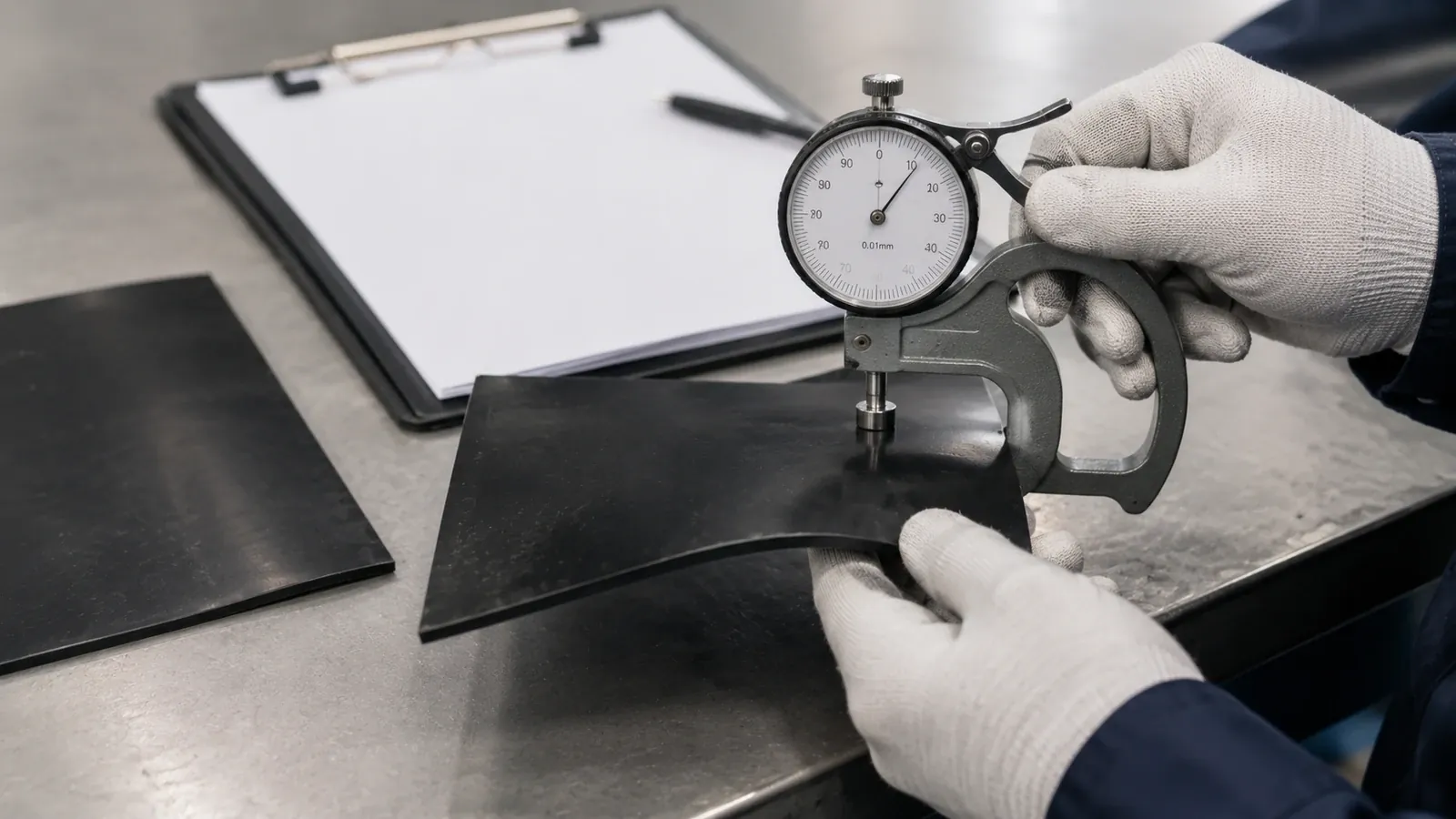
The specification is the product
Two sheets described as "1.5 mm HDPE geomembrane" can be very different products. What distinguishes them is the set of measured properties behind the description — and whether anyone has actually measured them for the rolls on your truck.
The reference document for HDPE geomembrane is GRI-GM13, published by the Geosynthetic Institute. It sets minimum property values by thickness for smooth and textured HDPE sheet, and names the ASTM test method for each. Nearly every consultant specification in the region either cites it directly or reproduces its table.
Below are the properties that matter, what each one tells you, and what to ask for at order stage.
Ask for a mill test certificate against GRI-GM13 carrying the roll numbers delivered to your site. One document settles almost every specification question on this page.
Key property values by thickness
| Property | 1.00 mm | 1.50 mm | 2.00 mm | Test method |
|---|---|---|---|---|
| Thickness (min. average) | 0.95 mm | 1.43 mm | 1.90 mm | ASTM D5199 |
| Density (min.) | 0.940 g/cm³ | 0.940 g/cm³ | 0.940 g/cm³ | ASTM D1505 / D792 |
| Tensile strength at yield | ≈ 15 kN/m | ≈ 22 kN/m | ≈ 29 kN/m | ASTM D6693 |
| Tensile strength at break | ≈ 27 kN/m | ≈ 40 kN/m | ≈ 53 kN/m | ASTM D6693 |
| Elongation at yield | 12 % | 12 % | 12 % | ASTM D6693 |
| Elongation at break | 700 % | 700 % | 700 % | ASTM D6693 |
| Tear resistance | ≈ 125 N | ≈ 187 N | ≈ 249 N | ASTM D1004 |
| Puncture resistance | ≈ 320 N | ≈ 480 N | ≈ 640 N | ASTM D4833 |
| Carbon black content | 2.0 – 3.0 % | 2.0 – 3.0 % | 2.0 – 3.0 % | ASTM D4218 |
| Carbon black dispersion | Categories 1–2 | Categories 1–2 | Categories 1–2 | ASTM D5596 |
| Stress crack resistance | ≥ 500 hr | ≥ 500 hr | ≥ 500 hr | ASTM D5397 (appendix) |
| Oxidative induction time (std.) | ≥ 100 min | ≥ 100 min | ≥ 100 min | ASTM D3895 |
Values are indicative and rounded for guidance. Always work to the current edition of GRI-GM13 and to the specific mill certificate supplied with your material. Send us your project specification and we will confirm compliance clause by clause.
What each property actually tells you
Thickness
Specifications quote a minimum average value, not a nominal one, because extrusion varies slightly across the web. If a quote says "1 mm nominal" without stating the minimum average, that is worth clarifying.
Density
Confirms the sheet really is high-density polyethylene rather than a lower-density blend. It is the quickest check that you have the material you paid for.
Tensile properties
Yield strength governs behaviour under normal service load; break elongation of around 700 % is what allows HDPE to stretch over settlement and subgrade irregularities without tearing.
Tear and puncture resistance
These are installation properties. Most damage happens while the liner is being handled, walked on and covered — not in service.
Carbon black content and dispersion
Content is how much UV protection is in the sheet; dispersion is how evenly it is distributed. Poorly dispersed carbon black creates weak spots regardless of how much is present. Both are measured for a reason.
Stress crack resistance
The property that predicts long-term brittle failure under sustained stress — the failure mode that shows up years later at a weld or a stress concentration. It is the single best indicator of a quality resin.
Oxidative induction time
Measures the antioxidant package that keeps the polymer stable through processing and long-term heat exposure. Directly relevant to service life on an exposed Gulf site.
Textured sheet and asperity height
Textured geomembrane carries the same core property requirements as smooth sheet, plus one extra: asperity height, measured to ASTM D7466. This is the height of the surface texture, and it is what generates interface friction on a slope.
A common specification value is a minimum average asperity height of around 0.40 mm. But asperity height is a proxy, not the answer — the property that actually matters for slope stability is the interface friction angle between the liner and whatever it touches, and that has to be measured by direct shear testing to ASTM D5321 on the actual materials. Where a designer has assumed a friction angle, it is worth confirming it by test before large areas are committed.
Welding and seam requirements
| Test | Method | Acceptance |
|---|---|---|
| Trial weld — peel | Field tensiometer | No peel separation at the weld interface; failure in the parent sheet (film tear bond) |
| Trial weld — shear | Field tensiometer | Meets or exceeds the specified shear strength for the sheet thickness, with elongation before break |
| Air pressure test | Dual-track seam channel | Pressure held over the specified duration within the allowed drop, then confirmed release at the far end |
| Vacuum box | Extrusion welds, patches | No bubbles under vacuum with soap solution applied |
| Destructive samples | Cut coupons, peel and shear | All coupons pass; failing samples trigger bracketed sampling either side to find the extent |
The confirmed release at the far end of an air pressure test matters more than people realise: without it, a blockage in the channel can look exactly like a passing seam. It is a small step that separates real testing from theatre. Full method detail is on the installation page.
Send us your project specification
Attach or describe the specification clauses and we will confirm, clause by clause, what can be supplied, what needs an alternative and what the material certificates will show.
Answers for specifiers & buyers
Frequently asked questions
What is GRI-GM13?
GRI-GM13 is the Geosynthetic Institute's specification for smooth and textured HDPE geomembrane. It lists minimum property values by thickness — density, tensile, tear, puncture, carbon black, stress crack resistance, oxidative induction time — and names the ASTM test method for each. It is the reference most UAE consultant specifications are built on.
What thickness tolerance applies to HDPE geomembrane?
Specifications work to a minimum average thickness rather than a nominal figure, typically around −5 % of nominal for smooth sheet, with a lower limit on individual readings. Textured sheet is assessed differently because the texture itself affects the measurement.
How much carbon black should HDPE geomembrane contain?
Between 2 % and 3 %, with dispersion assessed in categories to ASTM D5596. Too little and UV protection suffers; too much and the sheet's mechanical properties are affected. Dispersion matters as much as content — evenly distributed carbon black is what actually protects the polymer.
What does oxidative induction time tell me?
It measures the antioxidant package remaining in the sheet, which controls how long the polymer resists thermal and oxidative ageing. Higher OIT means a longer service life, which matters most for liner left exposed to sun and heat rather than buried.
Can you supply material to a different national standard?
Yes. Send the standard and the clauses that apply. Most requirements map closely onto GRI-GM13 property values, and where they do not, we will say so plainly rather than claiming compliance that the certificates will not support.
Related pages
- Geomembrane supplyGrades, certificates and roll schedules
- Installation and testingHow the seam criteria are met on site
- Price guideWhat each thickness costs
- Thickness guideChoosing a grade for your structure
Need a price on HDPE geomembrane this week?
Send the area, thickness and emirate. You get a written quotation with material data sheets attached — usually the same working day.