
HDPE Liner Sheet
Roll widths, sheet weights and the take-off method that stops you ordering to the plan area and running 38 % short on the last panel.
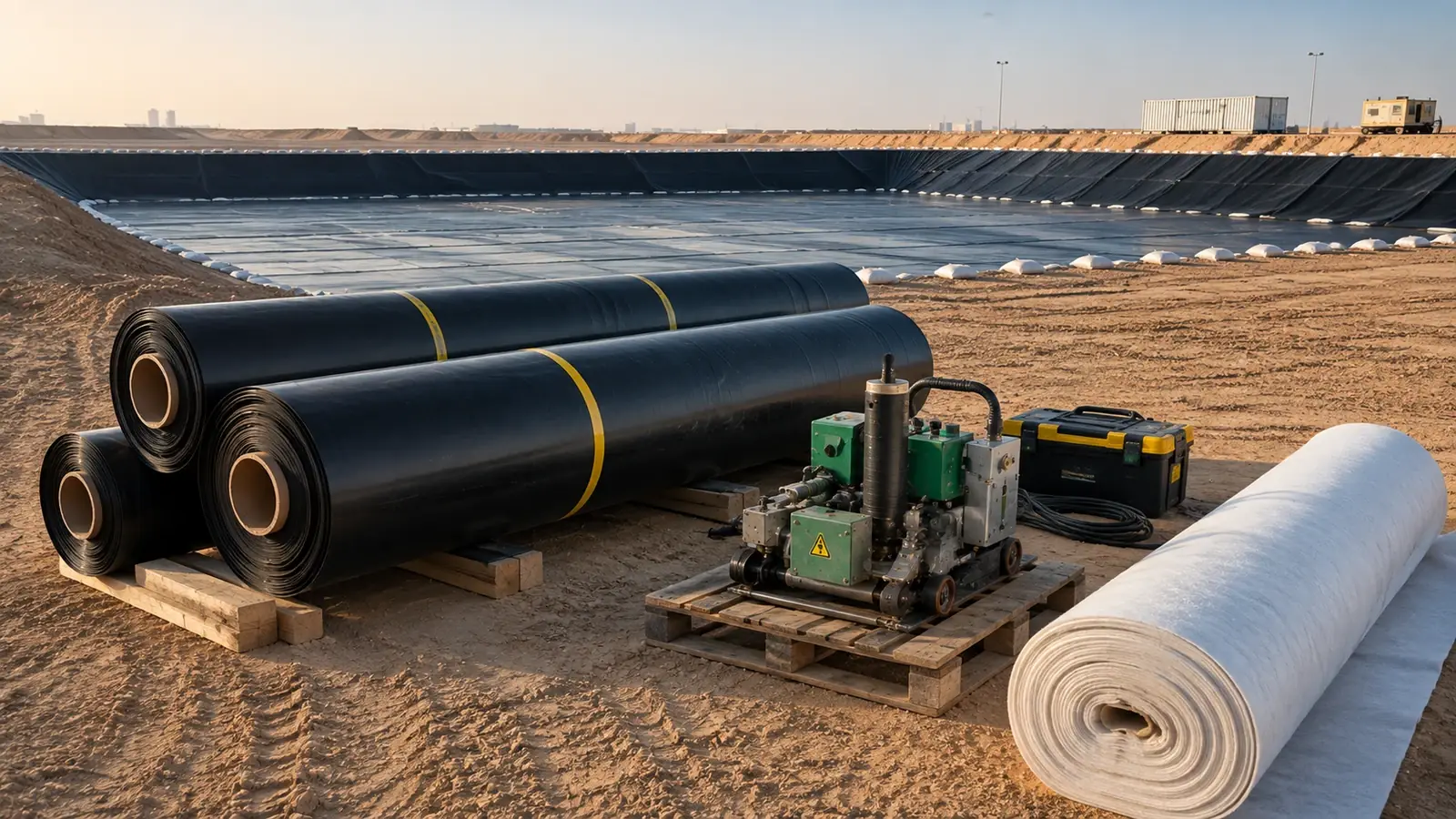
Sheet, roll or panel — what the words mean
People ask for HDPE liner sheet meaning three different things: material by the square metre, a roll as manufactured, or a pre-fabricated panel cut to a shape. The price and the lead time are different in each case, so it is worth being precise.
- Roll goods. Sheet as it comes off the line, wound on a core. This is the cheapest way to buy per square metre and how nearly all large jobs are supplied.
- Cut lengths. A roll cut to a stated length before dispatch. Useful when your site cannot handle a full roll weight.
- Pre-fabricated panels. Multiple widths welded together in a controlled environment, folded and palletised. More expensive per square metre, far quicker on site, and the right answer for tank linings, small ponds and difficult access.
All three are the same material and the same specification. What changes is how much welding happens in a factory versus in the open on your site.
| Thickness | Approx. weight |
|---|---|
| 0.50 mm | 0.48 kg/m² |
| 0.75 mm | 0.72 kg/m² |
| 1.00 mm | 0.96 kg/m² |
| 1.50 mm | 1.44 kg/m² |
| 2.00 mm | 1.92 kg/m² |
| 3.00 mm | 2.88 kg/m² |
Based on a nominal HDPE density of about 0.94–0.96 g/cm³. Use these to check roll weights and plan offloading plant.
How much sheet does your structure actually need?
The single most common ordering mistake is buying to the plan area. A reservoir's lined surface is always larger than its footprint, because the slopes and the anchor trench have to be covered too.
The quick method
- Take the base area of the excavation.
- Add the sloped surface: for each side, slope length × side length. On a 1V:2.5H slope, a 3 m deep reservoir has a sloped face about 8.1 m long, not 3 m.
- Add the anchor trench allowance — typically 1.0 to 1.5 m of extra sheet all the way round the crest.
- Add an allowance for seam overlap: each field seam consumes roughly 100–150 mm of sheet width.
- Add 3–5 % for trimming and waste, more if the shape is irregular.
A 50 m × 40 m reservoir, 3 m deep, with 1V:2.5H slopes and a 1.2 m anchor allowance needs roughly 2,760 m² of sheet — against a plan area of 2,000 m². Ordering to the plan area would leave the job about 38 % short.
Send us the dimensions and we will do the take-off and the roll schedule with the quotation, so the number you are quoted is the number of square metres that will actually arrive.
Roll widths and why they change your seam count
Field seams are the expensive part of an installation — each one has to be welded, tested and recorded. Choosing a roll width that suits the structure can remove several of them.
On a 40 m wide reservoir base, 5.8 m wide sheet needs seven panels and six seams. The same base in 8.0 m wide sheet needs five panels and four seams. That is a third less welding, a third less testing time, and two fewer places where a defect could occur.
Width is not free to choose — availability varies by thickness and finish — but it is one of the things we optimise when preparing a roll schedule rather than simply quoting square metres.
Practical width notes
- Wider sheet is heavier per roll and needs more capable offloading plant.
- On narrow structures like canals and channels, a single width running the length of the channel can eliminate transverse seams entirely.
- Panels are always laid so that seams run down the slope, never across it, so that any water movement follows the seam rather than pushing against it.
- Seams are kept out of corners and away from penetrations wherever the layout allows.
Smooth, textured, black or white
| Variant | Where it is used | Note |
|---|---|---|
| Smooth black | The default for water containment, reservoirs, ponds, canals | Easiest to weld and inspect; lowest cost per square metre |
| Single textured | Slopes with cover material above the liner | Textured face must be oriented towards the material it needs to grip |
| Double textured | Landfill cells, capping, steep slopes, liner sandwiched between layers | Highest interface friction; slower to weld |
| White over black | Large exposed areas, hot climates, sites needing easy defect spotting | Runs cooler than black sheet in Gulf sun, reducing installation wrinkling |
| Conductive backed | Cells where a full electrical leak location survey is required | Allows spark testing of the whole sheet, not just the seams |
Not sure which applies? Describe the structure on the enquiry form and the recommendation comes back with the quote — along with the reasoning, so you can challenge it.
Ask for a sheet take-off and roll schedule
Give us the area in square metres, the liner thickness and the application. We reply with a written quotation, material data sheet and an indicative delivery date.
Answers for specifiers & buyers
Frequently asked questions
What sizes does HDPE liner sheet come in?
Roll widths are commonly between 5.8 m and 8.0 m, with roll lengths chosen so the finished roll can still be handled on site — often 50 m to 150 m depending on thickness. Thinner sheet gives longer rolls. For awkward sites, material can be supplied as pre-fabricated folded panels instead of rolls.
How heavy is a roll of HDPE liner sheet?
Multiply area by the weight per square metre in the table above. A 7 m × 100 m roll of 1.5 mm sheet is roughly 700 m² at about 1.44 kg/m² — a little over a tonne. Always confirm the roll weight before arranging offloading plant.
Can HDPE liner sheet be cut and welded on site?
Yes — that is how nearly all lining is done. Sheet is cut with a hook knife and joined by hot wedge welding for long seams, with extrusion welding for patches, details and repairs. Both methods are described on the installation page.
Is HDPE liner sheet safe for drinking water or fish?
HDPE itself is chemically inert and is widely used for potable water pipe. For potable storage, ask for sheet with the relevant potable water approval documentation, since not every geomembrane grade carries it. For aquaculture, standard black HDPE geomembrane is used routinely worldwide.
What is the difference between HDPE liner sheet and pond liner?
"Pond liner" is an application, not a material. It may mean HDPE geomembrane, LLDPE, PVC, EPDM rubber or a woven reinforced sheet. HDPE is the most durable and chemically resistant of these and is what we supply; EPDM is more flexible but less UV-stable over decades in this climate.
Related pages
- Geomembrane supplyGrades, certificates and roll scheduling
- SpecificationsProperty values by thickness
- Thickness guideWhich grade suits which structure
- Sheet price guideCost per square metre and per square foot
Need a price on HDPE geomembrane this week?
Send the area, thickness and emirate. You get a written quotation with material data sheets attached — usually the same working day.