
Geomembrane Repair & Relining
A reservoir dropping faster than evaporation explains has one of three problems. We identify which, and say so even when the answer is the cheap one.
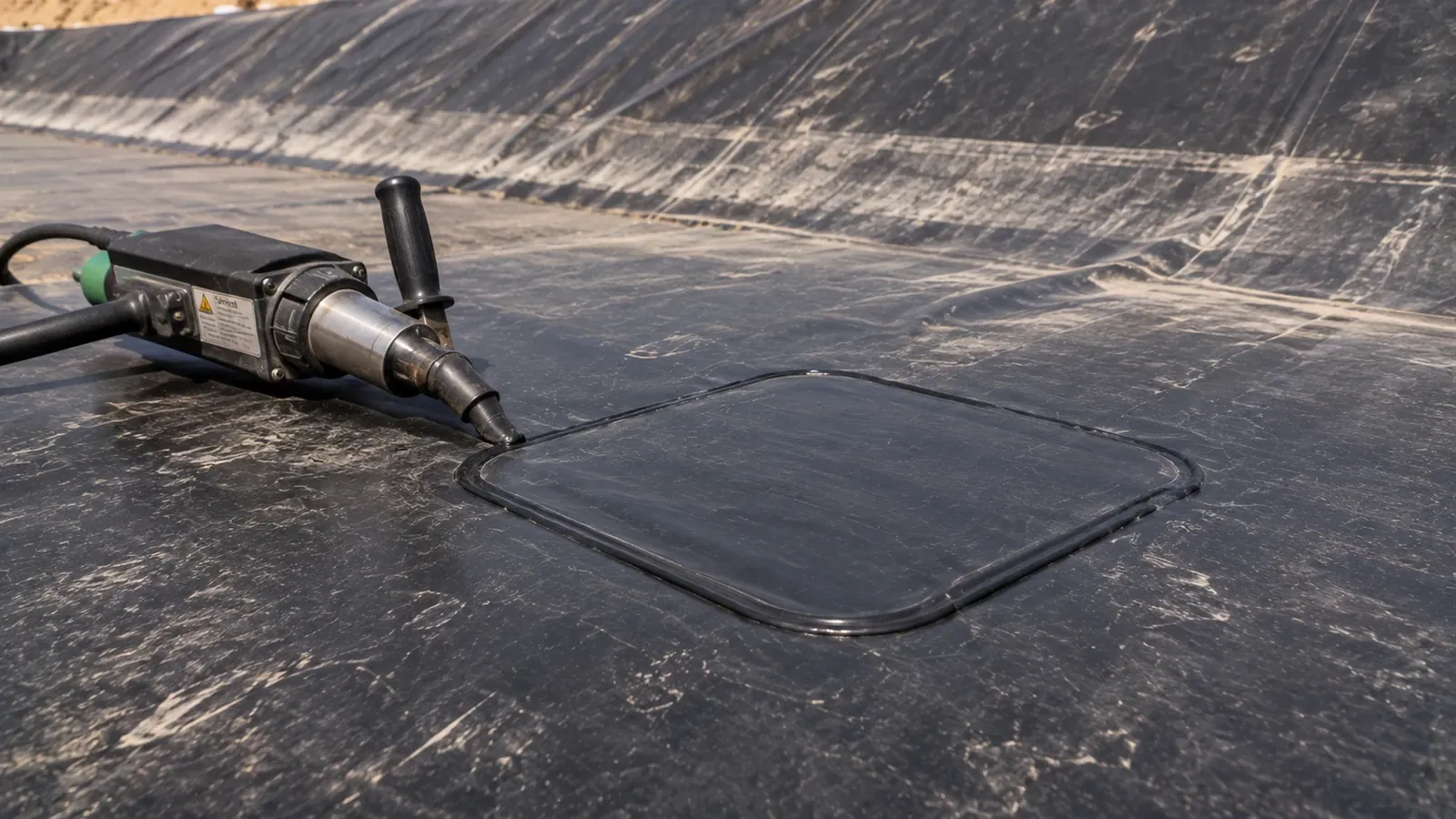
Your pond is losing water. Now what?
A reservoir that drops faster than evaporation explains is telling you something. The useful question is not "where is the hole" but "is this a defect, a detail, or a liner at the end of its life" — because the three have very different answers.
A defect is a puncture or a failed seam in otherwise sound sheet. It is patched, tested and forgotten.
A detail failure is a leak at a pipe penetration, a sump, a corner or the anchor trench. These account for a large share of real-world leaks, and repairing them properly usually means re-detailing rather than patching.
End of life is a liner that has become brittle — it cracks rather than flexes, chalks when rubbed, and cannot hold a weld. Patching this is money spent twice; it needs relining.
We will tell you which of the three you have, and we will say so even when the answer is the cheap one.
Close-ups of the sheet surface, any visible damage, the water line and the penetrations usually let us tell you what you are dealing with before anyone travels to site.
Finding the leak
| Method | How it works | When it is used |
|---|---|---|
| Visual and drawdown survey | The pond is drawn down in stages and the exposed liner walked and inspected, watching where the level stabilises | The first step on most exposed reservoirs, and often enough on its own |
| Air pressure re-test of seams | Accessible dual-track seams are re-pressurised to check whether the weld has failed along its length | Where the liner is sound but a seam is suspected |
| Vacuum box on details | Soap solution and a vacuum box applied over extrusion welds, patches and penetration details | Checking the areas statistically most likely to leak |
| Electrical leak location | A potential is applied across the liner and the sheet surveyed for current leakage paths | Large or covered cells where visual inspection is impractical; needs suitable conditions and access |
On covered liners, the economics change sharply — removing cover to find a defect can cost more than the repair. That is exactly why testing every seam at installation is worth paying for the first time round.
Repair methods
Patch repair
The area is cleaned and ground back to sound material, a patch of the same grade is cut with rounded corners, tacked in position and extrusion welded all round. It is then vacuum box tested and logged. Square corners on a patch concentrate stress and are the reason some repairs fail again — rounded corners are not cosmetic.
Seam repair
A failed section of seam is cut out or capped with an extrusion-welded strip over the full defect length, then retested. Where the seam has failed over a long run, replacing the panel is usually sounder than capping metre after metre.
Panel replacement
A damaged panel is cut out and a new one welded in. Practical where the surrounding liner is still in good condition and will take a weld — worth confirming with a test weld on an offcut before committing.
Full relining
Where the existing liner is brittle or has failed widely, the options are removal and replacement, or overlaying a new liner on top of the old one — the old sheet then acting as a separation layer. Overlaying is quicker and avoids disposal, but only works where the existing surface is stable and free of sharp projections.
Extending the life of a liner that is still sound
Not every ageing liner needs replacing. A few things genuinely extend service life:
- Keep it wet. Liner under water ages far more slowly than exposed liner. A reservoir kept largely full outlasts one that spends months empty in the sun.
- Keep traffic off it. Most in-service damage is mechanical. Establish a rule about who walks on the liner and in what footwear, and stick to it.
- Fix small damage promptly. A 20 mm puncture patched this month is trivial; the same puncture after a season of wave action and thermal cycling is a tear.
- Check the anchor trench after storms. Wind uplift and scour at the crest are common and easy to correct early.
- Inspect penetrations annually. Clamps loosen and boots move. This is a five-minute check that prevents the most common leak.
Describe the leak
Give us the area in square metres, the liner thickness and the application. We reply with a written quotation, material data sheet and an indicative delivery date.
Answers for specifiers & buyers
Frequently asked questions
Can a leaking HDPE liner be repaired?
Usually yes, provided the sheet is still flexible and will take a weld. Punctures and failed seams are patched by extrusion welding and vacuum tested. Where the liner has become brittle and cracks when flexed, welding to it will not give a dependable seam and relining is the honest recommendation.
How do you find a leak in a lined pond?
Normally by staged drawdown and visual inspection, supported by re-testing accessible seams and vacuum box testing of details and penetrations. For large or covered cells, electrical leak location can survey the sheet without emptying it, given suitable access and conditions.
Can you weld new liner to an old one?
Yes, where the existing material is HDPE and still sound. The surface is cleaned and ground back to clean polymer, then tacked and extrusion welded. We test a trial weld on an offcut of the existing sheet first — if that fails, no amount of site welding will fix it.
Is it cheaper to repair or reline?
Repair, by a wide margin, if the damage is localised and the liner is sound. Relining wins once you are chasing repeated leaks in an ageing sheet, because each repair cycle costs a drawdown, lost water and lost use of the reservoir.
Can you overlay a new liner on top of the old one?
Often, yes. The old sheet then acts as a separation layer, which avoids disposal and speeds the job up. It requires the existing surface to be stable, reasonably smooth and free of sharp projections — which is something we would confirm on site before quoting it.
Related pages
- Installation and testingWhy seam testing at install saves this later
- Protection layersPreventing the punctures that cause most leaks
- Lining systemsWhen a repair becomes a case for a new system
Need a price on HDPE geomembrane this week?
Send the area, thickness and emirate. You get a written quotation with material data sheets attached — usually the same working day.