
Pond & Reservoir Lining in the UAE
The single most common lining job in the country, and the one where small decisions at design stage have the biggest effect on whether it still holds water in ten years.
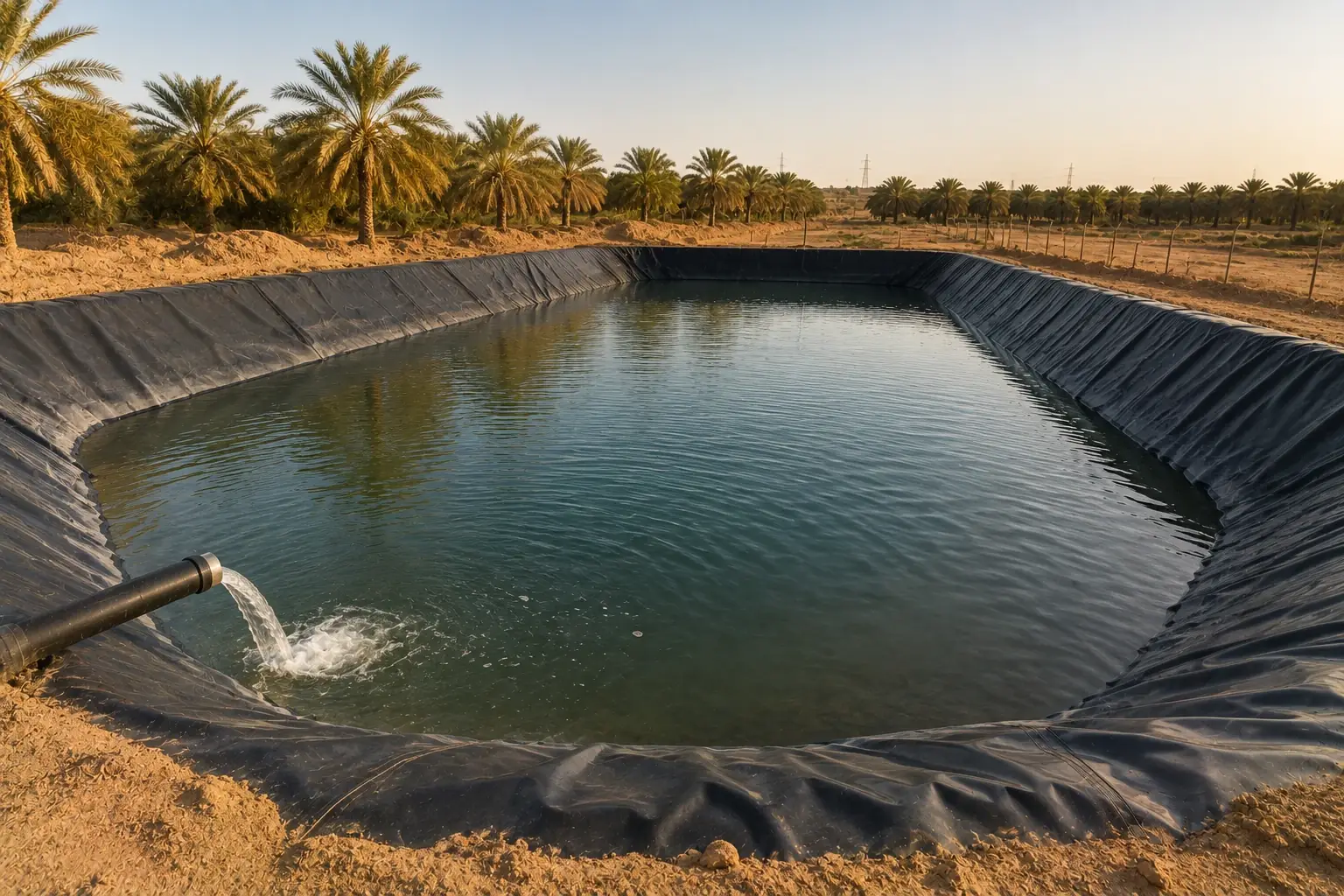
Why lining pays here
UAE soils are permeable, evaporation is high, and water — whether from a well, a tanker or a treated effluent line — costs money. An unlined earth reservoir loses water two ways: evaporation from the surface, and seepage into the ground. Lining eliminates the second entirely.
On a farm that fills a reservoir weekly, the seepage component alone usually pays for the liner within a small number of seasons. That is why the Al Ain region is the country's largest market for lined agricultural storage.
What lining does not do is stop evaporation. If your losses are mostly from the surface, that is a different conversation — floating covers and shade structures — and it is worth being clear which problem you are solving before you spend.
Getting the design right
Side slopes
1V:2.5H or flatter is the comfortable range for an exposed liner in sand. Steeper slopes mean higher tension in the sheet, more difficult installation, more risk of anything placed on the liner sliding, and a push towards textured material. If your excavation is already steeper than 1V:2H, discuss it before ordering material rather than after.
Freeboard
Leave enough height above the maximum water level that wind-driven waves cannot overtop the liner and scour behind it. On a large open reservoir this matters more than people expect.
Anchor trench
The liner is carried over the crest into a trench and backfilled. This resists wind uplift and the tension that develops as the sheet settles. Typical dimensions are a trench roughly 500 mm deep and 500 mm wide, set back from the crest, with rounded edges so the sheet is not cut as it turns.
Access
Decide now how you will get into the reservoir for cleaning and inspection, and how a pump will be placed without dragging across the liner. Retrofitting access means cutting.
Choosing thickness
0.75 mm suits a reservoir that stays largely full, on clean prepared sand, that nobody walks on regularly. 1.00 mm is the sensible choice where the liner is fully exposed for years, where the pond is drained and refilled often, or where the subgrade is coarse. Above 1.00 mm, you are usually buying resistance to mechanical damage rather than to water.
The thickness guide works through each grade in detail, and the price guide shows what the step costs.
The four details that leak
Inlet and outlet penetrations. Every pipe through the liner is a potential leak path. It needs a fabricated boot extrusion-welded to the sheet and clamped, or a puddle flange cast into a structure. This is skilled work and it is where cheap quotes economise.
The sump. Liner must follow the sump geometry without bridging across corners. Bridged sheet is under permanent tension and will eventually fail there.
Corners. The hardest part of any lining job. They need panel planning, not improvisation on the day.
The anchor trench. If it is a shallow scrape backfilled with loose sand, it is not an anchor and the first strong wind will demonstrate that.
Common mistakes
- Ordering to plan area. The lined surface includes slopes and anchor trench and can be nearly double the footprint.
- Skipping the geotextile on stony ground. The cheapest possible saving and the most expensive possible consequence.
- Laying panels in the afternoon heat. The sheet contracts overnight and pulls the seams.
- No ballast against wind. A partly welded panel that lifts is a lost day and damaged material.
- Leaving the reservoir empty for months. Exposed dry liner ages faster than liner under water.
- No seam testing. Filling a reservoir is a poor way to discover a defective seam.
Keeping it alive
Inspect penetrations once a year — clamps loosen. Check the anchor trench after storms. Repair small damage promptly, while it is still small. Keep vehicles and hard-soled boots off the liner. And keep the reservoir filled where you can, because water is the cheapest UV protection available.
If your reservoir has already started losing water, the repair and relining page covers how leaks are located and fixed. For a new structure, describe the dimensions to a supplier who lines UAE reservoirs every week and ask for the developed area, not the plan area, in the quotation.
Talk it through with someone who quotes this daily
Send your area, thickness and application. You get a written quotation with a roll schedule and material data sheet.
Answers for specifiers & buyers
Frequently asked questions
What is the best liner for a farm reservoir in the UAE?
HDPE geomembrane at 0.75 mm or 1.00 mm covers the large majority of farm reservoirs, with a geotextile cushion where the subgrade is stony. It combines UV durability in Gulf sun with weldable, testable seams.
How deep can a lined reservoir be?
Depth is limited by slope stability rather than by the liner. Flatter slopes make deeper reservoirs practical; steeper slopes push you towards textured sheet and, at some point, towards a geotechnical check on stability.
Does lining stop water evaporating?
No. Lining eliminates seepage into the ground. Surface evaporation continues and needs a cover — a floating cover or shade structure — if it is your dominant loss.
Can I line an existing earth reservoir without re-excavating?
Often yes, provided the slopes are stable and at an acceptable angle and the surface can be graded smooth and cleared of stone. What usually needs adding is a proper anchor trench at the crest, which most unlined earth reservoirs do not have.
Read next
- Lining systemsSingle, cushioned, composite and double liners
- Area take-offCalculating developed area including slopes
- Al Ain farm liningThe country's largest reservoir lining market
Need a price on HDPE geomembrane this week?
Send the area, thickness and emirate. You get a written quotation with material data sheets attached — usually the same working day.