
12 Installation Mistakes That Cause Leaks
Geomembrane rarely fails as a material. It fails as an installation. Here are the twelve errors that account for most of it, in roughly the order they occur on site.
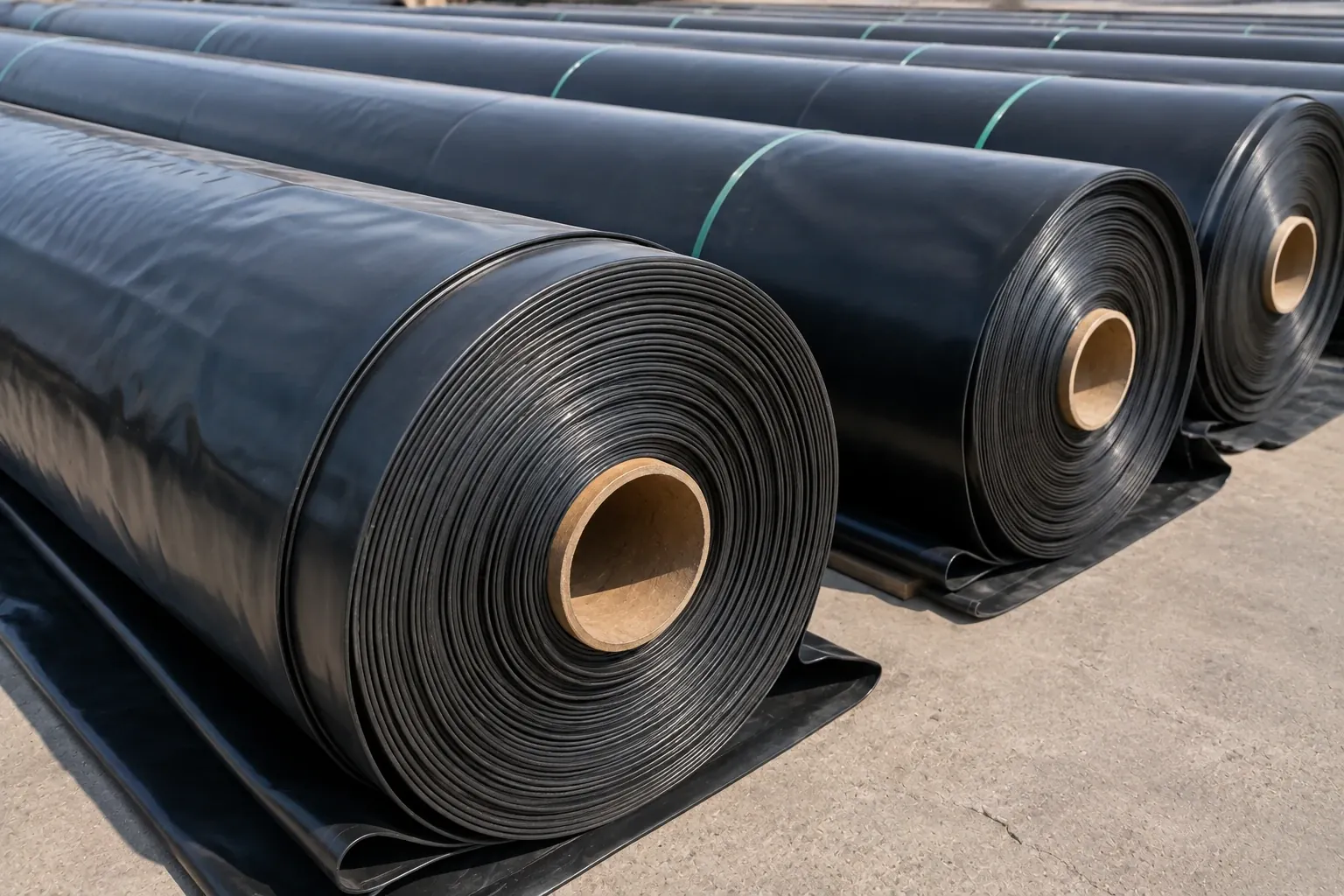
Before deployment
1. Accepting a subgrade that is not ready. Stones, ruts, debris, soft spots. More liners are punctured from below than from above. If the subgrade would be uncomfortable to lie down on, it is not ready for a liner.
2. Skipping the geotextile on stony ground. A cushion adds a fraction of the project cost and removes the single largest puncture risk. On gypsum crust, gravel or fill, omitting it is a false economy.
3. Ordering to plan area. Not a leak cause directly, but it produces the panic that leads to shortcuts: a job that runs short of sheet at the last panel gets improvised, and improvised details leak.
4. No anchor trench, or a token one. A shallow scrape backfilled with loose sand does not hold sheet against wind uplift or the tension that develops as the liner settles.
During deployment and welding
5. Deploying in the afternoon heat. Panels laid hot contract at night, pulling seams and bridging corners. Summer deployment belongs to the early morning.
6. Laying panels too tight — or too slack. Too tight and thermal contraction loads the seams. Too slack and you get waves that trap air and complicate cover placement. It is a judgement made against the temperature at the time of laying.
7. Inadequate ballast. Sandbags along every panel edge, continuously. A half-welded panel lifting in an afternoon breeze damages material and costs a day.
8. Welding without a current trial weld. Parameters that worked at 7 am do not necessarily work at 11 am. Trial welds are re-run when temperature, wind or operator changes — not once per project.
9. Extrusion welding onto unground surfaces. The oxidised skin must be ground back to clean polymer immediately before welding. A bead over an unground surface can look flawless and have almost no bond strength.
10. Square-cornered patches. Corners concentrate stress. Every patch should have rounded corners — it takes an extra ten seconds and prevents the repair failing again.
After the liner is down
11. Placing cover directly on bare liner. Drainage stone, soil or plant tracking straight onto the geomembrane will damage a sheet that passed every seam test. A protection geotextile goes above the liner wherever anything is placed on it.
12. No seam testing, or partial testing. Filling the structure is a poor way to discover a defect. Every dual-track seam can be air pressure tested end to end, and every extrusion weld vacuum tested. If it is not in the scope, it will not happen.
How to avoid all twelve
Every one of these is procedural rather than technical. They are avoided by a method statement that names the steps, a crew that follows it, and a document trail that proves it happened. That is precisely what a proper installation scope buys — not just labour, but the sequence and the evidence.
Ask an installer: "What do you do when a destructive test fails?" The right answer is bracketed sampling either side of the failure to find its extent, repair, retest, and log it. Anything vaguer means they have not had many failures — which usually means they have not run many tests.
If your liner is already installed and losing water, the repair and relining page covers leak location and patching. If you are still at the planning stage, describe the structure to a team that installs and tests geomembrane across the UAE and ask for the method statement alongside the price — how a supplier answers that request tells you most of what you need to know.
Talk it through with someone who quotes this daily
Send your area, thickness and application. You get a written quotation with a roll schedule and material data sheet.
Answers for specifiers & buyers
Frequently asked questions
What causes most geomembrane failures?
Installation, not material. Subgrade punctures, poor detailing at penetrations, seams welded outside proven parameters and damage during cover placement account for the great majority of real-world leaks.
Can a liner leak even if every seam passed testing?
Yes — most commonly through damage that happens after testing, during cover placement or plant movement, or through details that were never testable in the first place. A protection geotextile and careful cover placement address the first; proper detailing addresses the second.
How soon after installation do problems usually appear?
Puncture-related leaks often show as soon as the structure is filled. Stress-related failures at bridged corners or over-tensioned seams can take months or years, which is why deployment slack and anchor detailing matter more than they appear to.
Is it worth paying extra for full seam testing?
On anything you cannot easily drain, or that a consultant must accept, yes without qualification. Testing typically adds a few dirhams per square metre; locating a leak in a full reservoir costs far more than that across the whole area.
Read next
- Installation scopeThe method these mistakes are avoided by
- Welding methodsHow seams are made and verified
- Protection layersStopping punctures from both directions
Need a price on HDPE geomembrane this week?
Send the area, thickness and emirate. You get a written quotation with material data sheets attached — usually the same working day.