
HDPE vs LLDPE Geomembrane
Both are polyethylene. One is stiffer and more chemically resistant, the other stretches further before it tears. The right answer depends on whether your ground is going to move.
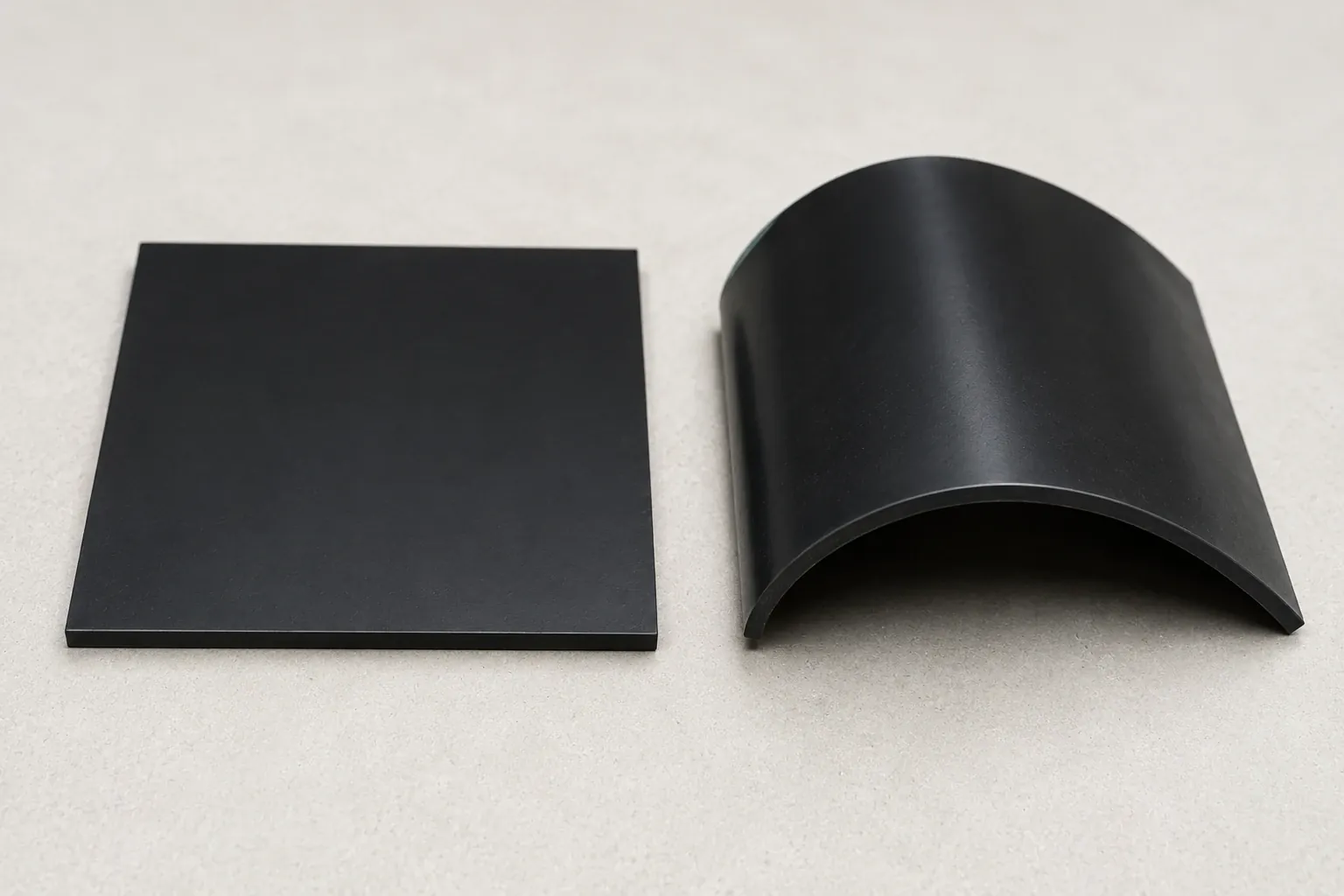
The actual difference
Both are polyethylene; the difference is molecular structure. HDPE has long, mostly unbranched chains that pack tightly together, giving higher density, more crystallinity, greater stiffness and better chemical resistance. LLDPE has short branches that prevent tight packing, giving lower density, more flexibility and much greater elongation before failure.
Everything else follows from that. HDPE is the more resistant material; LLDPE is the more forgiving one.
Side by side
| Property | HDPE | LLDPE |
|---|---|---|
| Density | ≥ 0.940 g/cm³ | ≤ 0.939 g/cm³ |
| Stiffness | Higher — holds its shape, harder to conform | Lower — drapes readily over irregular ground |
| Elongation at break | ≈ 700 % | ≈ 800 % or more |
| Chemical resistance | Excellent, the benchmark | Very good, slightly below HDPE |
| Stress crack resistance | Good in quality resin, but stress cracking is the classic HDPE failure mode | Substantially better — far less prone to stress cracking |
| UV durability | Excellent with 2–3 % carbon black | Excellent with the same carbon black package |
| Weldability | Excellent | Excellent, slightly different parameters |
| Relative cost | Lower for the same thickness | Usually a little higher |
When HDPE wins
- Exposed containment. Long-term exposed liner is HDPE's home ground.
- Aggressive chemistry. Leachate, brine, industrial effluent — HDPE has the edge.
- Stable subgrade. Where the ground will not settle differentially, HDPE's stiffness costs you nothing.
- Cost sensitivity. For a given thickness it is normally the cheaper sheet.
- Almost all UAE water storage. Reservoirs on stable, well-prepared sand are exactly what HDPE is for.
When LLDPE wins
- Differential settlement expected. Landfill capping over waste that will settle unevenly is the classic case — LLDPE stretches where HDPE would crack.
- Irregular subgrade that cannot be improved. LLDPE conforms to what it is laid on.
- Complex geometry. More corners, more detail, more benefit from a sheet that drapes.
- Stress concentration risk. Where a liner will be locally strained around a structure, LLDPE's stress crack behaviour is a genuine advantage.
What that means in the UAE
For the overwhelming majority of work in this market — irrigation and municipal reservoirs, aquaculture ponds, canals, secondary containment bunds, landfill base lining — HDPE is the correct specification. The ground is generally stable once prepared, exposure is the dominant stress, and chemical resistance matters.
LLDPE comes into its own on landfill capping, where the surface beneath will settle for years, and on irregular sites where achieving a good subgrade is impractical. It is a specialist answer to a specific problem rather than a general upgrade.
If you are unsure which your project needs, the deciding question is simple: is the ground beneath this liner going to move? If yes, consider LLDPE. If no, specify HDPE and spend the difference on a thicker sheet or a better geotextile. Our geomembrane supply and installation service covers both, and the specification page lists the property values you will be comparing.
Talk it through with someone who quotes this daily
Send your area, thickness and application. You get a written quotation with a roll schedule and material data sheet.
Answers for specifiers & buyers
Frequently asked questions
Is LLDPE better than HDPE?
Not better, different. LLDPE is more flexible and far less prone to stress cracking, which suits settling subgrades and capping systems. HDPE is stiffer, more chemically resistant and cheaper for the same thickness, which suits most containment work.
Can HDPE and LLDPE geomembrane be welded together?
They can be fused, but the weld parameters differ from either material welded to itself and the resulting seam properties should be verified by trial welds and destructive testing before relying on it. Mixing polymers in one structure is best avoided unless the design specifically calls for it.
Which is used for landfill lining?
HDPE for base lining, where chemical resistance against leachate dominates. LLDPE is frequently specified for capping, where the liner has to accommodate years of differential settlement in the waste beneath it.
Does LLDPE last as long as HDPE?
With the same carbon black and antioxidant package, UV durability is comparable. HDPE holds a chemical resistance advantage; LLDPE holds a stress cracking advantage. Service life depends more on resin quality, thickness and installation than on the choice between the two.
Read next
- The geomembrane familyWhere HDPE and LLDPE sit among the alternatives
- Thickness guideChoosing a grade once you have chosen the polymer
- SpecificationsProperty values and test methods
Need a price on HDPE geomembrane this week?
Send the area, thickness and emirate. You get a written quotation with material data sheets attached — usually the same working day.