
Landfill Lining Systems Explained
The most heavily specified lining work there is, and the place where documentation carries as much weight as the sheet itself.
What a landfill liner is for
Waste generates leachate — rainfall and moisture percolating through the mass, picking up dissolved and suspended contaminants. Untreated, that liquid reaches groundwater. A landfill lining system exists to contain it, collect it and route it to treatment.
Which is why these systems are designed with redundancy that a farm reservoir would never justify. The consequence of failure is not lost water; it is contaminated aquifer.
The base lining system
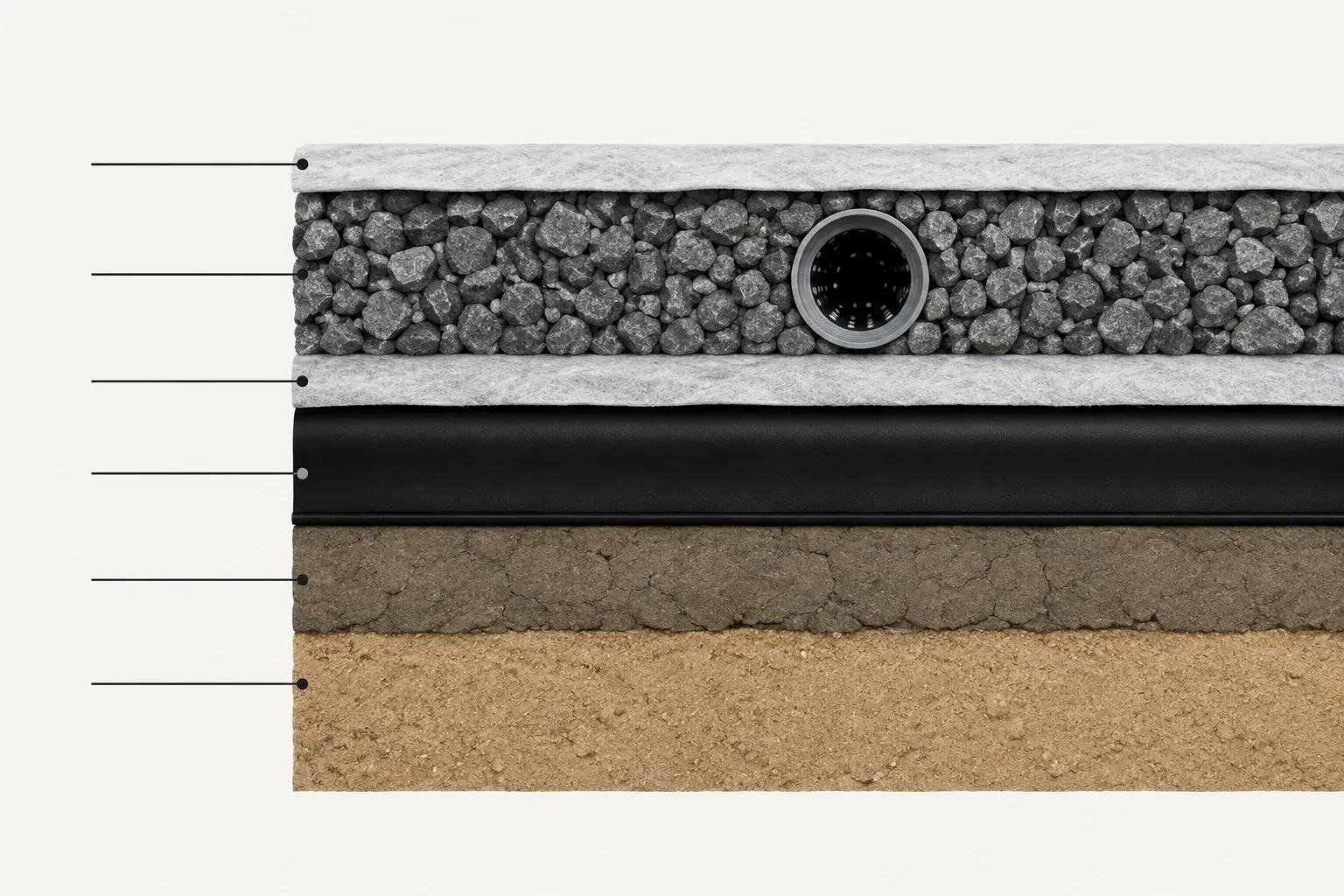
A typical engineered base build-up, from the ground upward:
- Prepared subgrade — shaped, compacted, proof-rolled, free of anything angular.
- Compacted clay liner or GCL — a low-permeability mineral layer providing the first barrier and, importantly, a redundant one that behaves differently from plastic.
- HDPE geomembrane — typically 1.5 mm to 2.0 mm, textured on slopes for friction. This is the primary barrier.
- Protection geotextile — heavy non-woven, guarding the liner from the drainage stone above.
- Leachate collection layer — granular drainage stone or a geocomposite drainage layer, with perforated collection pipework.
- Separation geotextile — keeping waste out of the drainage layer so it does not clog.
The geomembrane and the mineral layer together form a composite liner. The combination performs better than either alone, because a defect in the sheet has to find a leak path through the clay directly beneath it, and intimate contact between the two makes that path very restricted.
Higher-risk cells add a second geomembrane beneath the first, separated by a geonet drainage layer that drains to a monitored sump — a double liner with leak detection. If the primary sheet leaks, you know, and you know roughly how much.
Leachate collection
Containment without collection just makes a bathtub. The drainage layer and collection pipework carry leachate to a sump, from which it is pumped to storage or treatment. Sump construction is a demanding piece of lining work — the geometry is complex, the liner must not bridge, and the pipe penetrations have to be detailed carefully.
Leachate storage lagoons are themselves lined, almost always as double-lined structures with leak detection, because the liquid is at its most concentrated there.
Capping systems
When a cell is filled, it is capped to keep rainfall out — which reduces leachate generation at source — and to control landfill gas. A capping build-up typically comprises a regulating layer over the waste, a gas collection layer, a geomembrane barrier, a drainage layer, and a soil restoration layer.
Capping is the classic case for LLDPE rather than HDPE, because the waste beneath will settle unevenly for years and the barrier has to stretch rather than crack. The comparison is covered in HDPE vs LLDPE.
CQA — why the paperwork is the product
Construction Quality Assurance is the documented evidence that the lining system was built as designed. On a landfill it is not administrative overhead; it is the deliverable a regulator or consultant actually inspects. A complete package includes:
- Subgrade acceptance records, signed and dated before deployment
- Material conformance certificates traceable to delivered roll numbers
- Panel layout as-built drawing with every panel and seam numbered
- Trial weld results for each shift, machine and operator
- Air pressure test log for every dual-track seam
- Vacuum and spark test records for extrusion welds and details
- Destructive test results in peel and shear, with bracketed sampling where a test failed
- Repair register with locations, methods and retest results
- Interface friction test data where slope stability depends on it
If any of that is missing, the cell may be perfectly built and still fail to be accepted — because there is no evidence that it was. Our installation page sets out the methods behind each record, and we quote landfill work to the specification's actual clauses rather than to a generic assumption. Send yours through the enquiry form and it will come back reviewed clause by clause.
Talk it through with someone who quotes this daily
Send your area, thickness and application. You get a written quotation with a roll schedule and material data sheet.
Answers for specifiers & buyers
Frequently asked questions
What thickness of geomembrane is used in landfill?
Commonly 1.5 mm to 2.0 mm HDPE for base lining, textured on side slopes for interface friction. Capping is often thinner and frequently LLDPE, chosen for its ability to accommodate settlement.
What is a composite liner?
A geomembrane placed in intimate contact with a low-permeability mineral layer — compacted clay or a geosynthetic clay liner. The combination performs better than either alone because any defect in the sheet has a very restricted leak path through the mineral layer beneath.
What is a leak detection layer?
A drainage layer between two geomembranes in a double-lined system. Anything that escapes the primary liner is collected and drained to a monitored sump, so a leak is detected and quantified rather than discovered years later.
Why is CQA documentation so important on landfill projects?
Because it is the only evidence the system was built as designed. A regulator cannot inspect a buried liner. The seam test logs, weld records and as-built drawings are what the sign-off is actually based on.
Read next
- Lining system configurationsSingle, composite and double liners
- Installation and CQAThe methods behind each record
- Protection layersCushion and separation geotextiles
Need a price on HDPE geomembrane this week?
Send the area, thickness and emirate. You get a written quotation with material data sheets attached — usually the same working day.