
What Is a Polyethylene Geomembrane?
It is a sheet of plastic that liquid cannot pass through, manufactured in wide rolls and welded on site into one continuous barrier. Everything else is detail — but the detail is where projects succeed or leak.
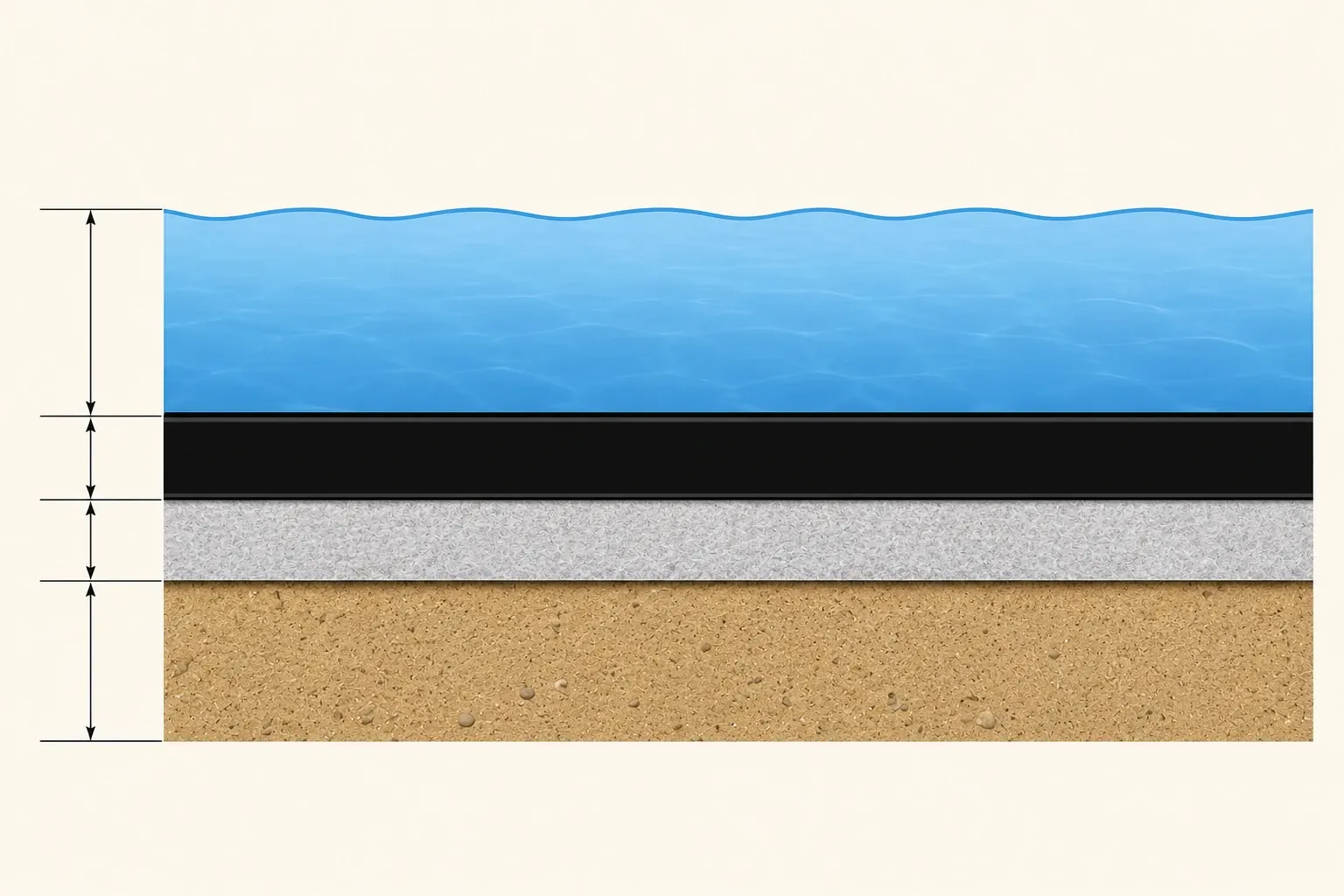
The definition
A polyethylene geomembrane is a continuous, essentially impermeable synthetic barrier made from polyethylene resin, used in geotechnical and environmental engineering to control the movement of liquid or gas. In practice: a big plastic sheet that stops water going where you do not want it.
The engineering value lies in the word continuous. A single sheet is trivially impermeable. Turning many sheets into one barrier across ten thousand square metres, over slopes and around pipes, without a single flaw — that is the actual product you are buying.
How it is manufactured
Polyethylene resin, carbon black and an antioxidant package are blended and extruded, either through a flat die or as a blown cylinder that is slit and flattened. The sheet is cooled, gauged for thickness, wound onto cores and given a roll number that follows it through testing and dispatch.
Texture, where required, is applied during extrusion — commonly by co-extruding a blowing agent that creates a rough surface, giving the sheet the friction it needs on a slope. Testing happens per batch: thickness, density, tensile properties, tear and puncture, carbon black content and dispersion, stress crack resistance and oxidative induction time. Those results become the mill certificate that should arrive with your delivery.
How impermeable is impermeable?
Intact HDPE geomembrane has a permeability in the order of 10⁻¹³ cm/s. For comparison, well-compacted clay is typically around 10⁻⁷ cm/s. The geomembrane is roughly a million times less permeable.
Which means that in any real installation, the sheet is not the leak path. Leaks come from seams, from punctures during installation or covering, and from penetrations. Published field surveys of installed liners consistently find that the overwhelming majority of defects are installation-related rather than material defects.
That is why the money and attention belong on subgrade preparation, welding and testing — the subjects of our installation and seam testing page — rather than on chasing the last dirham off the material rate.
What it is used for
- Water containment — irrigation and municipal reservoirs, canals, decorative lakes, firewater storage, aquaculture ponds.
- Waste containment — landfill base lining and capping, leachate lagoons, ash and tailings storage.
- Industrial containment — secondary containment bunds, evaporation ponds, process water and effluent storage.
- Mining and brine — heap leach pads, salt and brine ponds.
- Ground protection — gas barriers under buildings, contaminated land capping.
In the UAE the first category dominates by volume, and the supply of HDPE geomembrane liner across the Emirates is driven mostly by water storage — which is unsurprising in a country where stored water is expensive and the ground is permeable.
What it cannot do
It does not stop evaporation. Lining a reservoir eliminates seepage. Surface evaporation carries on regardless and needs a cover if it is your dominant loss.
It does not fix a bad subgrade. Laid over sharp material, it will be punctured, and the thinner the sheet the faster that happens.
It does not resist everything. HDPE handles most acids, alkalis, salts and alcohols, but some hydrocarbons and strong oxidisers are problematic. Chemical compatibility should be confirmed against the specific liquid, concentration and temperature.
It does not tolerate heat. Continuous service above roughly 60 °C is outside HDPE's comfortable range. That is rarely an issue for stored water, but it matters for process liquids.
It is not self-installing. The material arrives with certified properties. Whether those properties survive to become a watertight structure depends entirely on what happens next.
Talk it through with someone who quotes this daily
Send your area, thickness and application. You get a written quotation with a roll schedule and material data sheet.
Answers for specifiers & buyers
Frequently asked questions
What does geomembrane mean?
A geomembrane is a manufactured, essentially impermeable barrier used in civil and environmental engineering to control liquid or gas movement. "Geo" refers to its use in and on the ground; "membrane" to its sheet form.
How thick is a typical polyethylene geomembrane?
Between 0.5 mm and 3 mm. Water storage typically uses 0.75–1.0 mm; landfill and regulated containment usually starts at 1.5 mm. Thickness is chosen from installation risk, service loads and required design life rather than from the liquid's pressure.
Is polyethylene geomembrane safe for fish and irrigation water?
Yes — HDPE is inert and is used worldwide for aquaculture and irrigation storage. For potable water, ask specifically for material with potable approval documentation, since not every geomembrane grade carries it.
How long will a polyethylene geomembrane last?
Buried or covered liner has a design life measured in many decades. Exposed liner ages faster, and the rate depends on the carbon black and antioxidant package, the thickness and the surface temperature. Well-compounded exposed HDPE in this climate is still expected to give decades of service.
Read next
- Is HDPE a geomembrane?How the polymer and the product relate
- Lining systemsWhat goes above and below the barrier
- SpecificationsThe properties measured on every batch
Need a price on HDPE geomembrane this week?
Send the area, thickness and emirate. You get a written quotation with material data sheets attached — usually the same working day.